ZhangYvJing's

Daily Brief

← May 26, 2026 May 27, 2026 · Wednesday May 28, 2026 →
00

Film / Book Chapter

Good Will Hunting
1997 / Gus Van Sant

Good Will Hunting (1997) · Gus Van Sant

《Good Will Hunting》像一场代码审查,把潜在的天才与自我设限的错误抠出来,让你在面对今天被工具链、自动化与跨平台调试占满的焦虑时,重新审视“真正想做的事”和“谁在帮你指路”,提醒你把对能力的羞耻转化为主动的导师‑ mentee 对话,从而在接下来的产品迭代与 Agent 架构决策中,先给自己一个清晰、敢于暴露缺口的心态基准。

The Pragmatic Programmer
David Thomas / Andrew Hunt

The Pragmatic Programmer · David Thomas / Andrew Hunt

Chapter 1: A Pragmatic Philosophy

A compact reset on ownership, taste, entropy, and being the kind of engineer whose work keeps improving after the first pass.

01

Insight

今天的材料透露出两条清晰的趋势:一是从 UI 细节到底层硬件,整个技术栈都在向“极致轻量化、可编程化”收拢;二是围绕大模型的系统层(memory、检索、工具路由)开始成为性能和安全的瓶颈,而不是模型本身的规模。Hacker News 中像素字体、Git 驱动的排版流水线以及 2 像素极简字体的实验,都是在把传统的艺术与 UI 设计重新抽象成代码化、可版本化的资产,说明业界已经把“界面即代码”当作降低跨平台调试成本的核心手段。与此同时,Rosalind 用 100 MB 内存跑全基因组、Minicor 用自愈代理实现大规模 Windows RPA,正好映射出硬件与软件的边界正在被压缩——只要把资源模型化,就能把医院工作站或企业桌面变成可部署的 “边缘服务器”。YouTube 那几场关于 Agent 的讨论进一步点出,模型的原始算力并不是唯一价值,Angus McLean 提倡“bounded autonomy”、Phil Hetzel 说 GenAI 不能只留给平台团队、Nicholas Kang 与 Michael Aaron 打出的评测平台泄露出同一信息:在同等算力下,如何组织上下文、如何构建可审计的执行 harness 才决定了真实产品的可用性。arXiv 则提供了可操作的技术路径:OrpQuant 用几何投影把 PoT 量化搬到 3 bit 仍保持低困惑度,LoopMDM 通过层循环在保持 FLOPs 大幅下降的同时提升推理分数,而“Language Models Need Sleep” 与“From Model Scaling to System Scaling” 直接呼应了 YouTube 的系统化呼声——把计算搬到离线 “sleep” 或者把记忆治理、动态技能路由做成模块化框架,才是真正的突破口。综合来看,今天的噪声主要集中在对单一大模型的盲目追求(比如把所有精力投在更大 GPT‑4),而真正的创新在于把模型包装进轻量、可编程、可审计的系统层,这与 Bilibili 上的技术社区对“代码即字体”的调侃形成有趣对照:表面是审美和怀旧,底层却是可追溯的工程实践。面对这种局面,阅读时应关注哪些方案把算力、内存和上下文治理抽象为可替换的组件,而不是单纯的模型规格;在项目选型时优先考虑那些提供完整 harness 或插件化微调(如 Prism)的工具链。今天的洞察提醒我们:真正的竞争力在于把大模型的能力封装进可部署、可维护的系统,而不是让模型独自背负所有负担——这也是《Good Will Hunting》里那句“有天赋的人必须学会用自己的方式解决问题”的现代技术写照。
03

Hacker News

01
A few interesting modern pixel fonts
像素字体正被重新包装为可在现代系统直接使用的矢量字体。设计者们通过提升基线、内置彩色晕影或压缩到仅两像素高度,解决了传统像素字在不同视口下失真、度量冲突以及仅作装饰的局限。由于这些字体兼顾视觉纹理和排版精度,界面设计团队在跨平台实现时可以降低调试成本、避免渲染错误,并遵循更统一的排版规则。
02
作者把小说的排版、校对和发行全部搬到 Git 管理的工作流中,摒弃了传统的 Adobe InDesign 与 Kindle Create 以及 Windows Word 的多环节转换。由于 Word 在微排版上缺乏专业功能、InDesign 与 Kindle Create 只能在特定平台运行且需要重复生成 PDF、EPUB 与 KPF,作者转而使用 LibreOffice/ODT 编写文稿,再通过 Calibre 转 EPUB、standardebooks 工具链进行严格的样式检查并在 Git 中保存所有 XHTML 源文件,最终得到兼容所有阅读设备的 EPub。此流程将排版改为可追溯、可自动化的代码化过程,降低了跨平台软件依赖和手工维护成本,且为独立作者或小型出版团队提供了更可靠的版本控制与质量保障。
03
Rosalind 将基因组比对、变体检测和自定义生物信息分析从传统需 50‑100 GB 内存的工作流,压缩至笔记本约 100 MB 即可跑完整基因组。它通过把任务划分为 √t 块、仅保留滚动块边界并在块内使用高度压缩的树结构,使工作集始终驻留在 L1/L2 缓存,实现了确定性重放和无损的子线性内存占用。该方案让医院工作站、现场实验室和教学笔记本能够在本地完成临床诊断、疫情监测或教学实践,显著降低对高性能数据中心和网络传输的依赖,削减成本并降低敏感数据外泄风险。
04
The Ballad of TIGIT
Roche 在 2024 年 11 月公布的终末 OS 分析显示,抗 TIGIT 药物 tiragolumab 未能提升关键生存指标,终止了其此前被寄予“比 Keytruda 更佳”期待的临床前景。此前该药因理论上可同时解除多重免疫抑制、加速免疫活化而在多个适应症同步展开大规模Ⅲ 期试验,且在 2020 年的 II 期数据显示响应率显著高于对照,促使公司投入数十亿美元并获批突破性治疗 designation。此次失败使得各大制药公司必须重新评估对 TIGIT 目标的研发投入、临床试验布局及风险管理策略。
06
Minicor 在 Windows 桌面推出了可大规模部署的自愈自动化代理,使得通过单次 API 调用即可启动完整的桌面工作流并实时校验屏幕操作。该平台通过在 UI 变化或弹出意外对话框时自动捕获并调整,同时记录全程视频和截图以供即时调试,解决了传统 RPA 难以维护、错误率高的痛点。结果是医疗、制造、物流等领域的工程团队可以在几天内上线自动化,显著降低维护成本和因脚本失效导致的业务风险。
07
What color is your function? (2015)
作者构造了一种假想语言,让每个函数必须标记为红色或蓝色,并规定红函数只能由红函数调用、调用方式必须匹配颜色;这种设定使得高阶函数在传递和调用时必须考虑颜色兼容性,而语言又强制保留若干只能红色调用的核心库函数;因此使用该语言的开发者在设计 API、复用代码时需额外编码颜色逻辑,导致代码复杂度上升、维护成本增加,并增加因错误颜色调用而产生的运行风险。
04

YouTube

01
Angus McLean spent time building a complex agent application to generate his CV. Four letters beat it: HTML. He puts the improvement at 100x. The talk is from Oliver's AI Director, where agents generate around 4,000 creative assets a day for 200 plus brands, assets you have probably seen and had no idea were AI. The core argument: models are naturally verbose and tend toward complexity, and so are the developers working with them. His counter is to strip back. Replace internet access with curated documentation, ask how little context you can use and still complete the task, and never automate
agent, ai_product, engineering
02
Full episode: https://youtu.be/PAIhVfGbREA Me on x: https://x.com/dwarkesh_sp Renaissance historian Ada Palmer explains why Italy – the richest region in Europe – never unified, how the Pope had the money and armies to conquer Italy but couldn't consolidate, and why Machiavelli believed regime change always costs more lives than tyranny.
ai_frontier, market, problem_definition
03
At most traditional enterprises, GenAI got handed to the ML platform team because it had AI in the name. Phil Hetzel from Braintrust argues that was the wrong move, not because data scientists lack value, but because Anthropic and OpenAI already ran the data pipeline. What is left is prompt and context engineering, distributed systems, human annotation, and functional evaluation across a much broader surface area than precision and recall. The mistake is isolating it to one team. The answer is a diverse one. Speaker info: - https://www.linkedin.com/in/philliphetzel
agent, ai_product, engineering, market
04
On SWE-Bench Pro, six frontier models land within a couple of percentage points of each other. The harness they run inside shifts performance by 22%. A competing lab once took a Kaggle benchmark, reran it with their own compaction settings, and published much better results. Neither number was wrong. Both were useless. The talk is from Nicholas Kang and Michael Aaron at Google DeepMind's Kaggle team, who are building the infrastructure to fix evals at the community level: an open benchmark platform anyone can contribute to, a PvP Game Arena where models play poker and chess for an ELO rating
agent, ai_frontier, ai_product, engineering, market
08
Cursor's Federico Cassano and Fireworks' Dmytro Dzhulgakov explain how they collaborated to build Composer as a specialized foundation model. The core insight: models have finite capacity in their weights, and allocating all those bits to the singular task of software engineering in Cursor frees the model to be both better at the task and far more efficient at inference. Rather than start from pre-training and work up, they took an unconventional top-down approach — mid-training and RL on top of an open-source base to get a useful model into users' hands fast, then specializing the model aroun
agent, ai_frontier, ai_product, market, startup
09
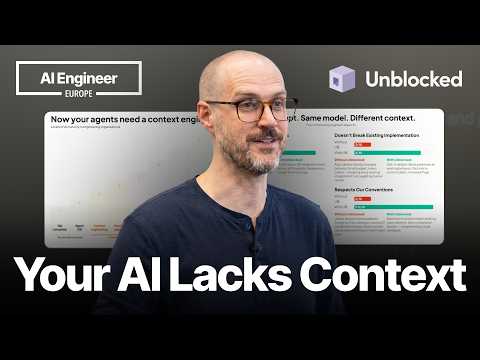
Same prompt. Same agent. Same model. Without a context engine: 2.5 hours, 20.9 million tokens, multiple rounds of human correction, and code that compiled but would have broken the entire system if it shipped. With one: 25 minutes, 10.8 million tokens, and a senior engineer who gave one nitpick and approved the merge. Brandon Walsenuk from Unblocked makes the case that the problem is not access but understanding. More MCPs give agents pipes to information. A million token context window just sits there. Naive RAG stops at the first result it finds, a phenomenon called satisfaction of search b
agent, ai_product, engineering
10
Harvey, Cursor, Manus, and Claude operate in completely different domains but share four patterns: focus modes that constrain the action space to improve output quality, transparent execution that surfaces tool calls and reasoning to build user trust, personalization that optimizes for speed to understanding rather than just speed to output, and reversibility that bounds the downside of mistakes so users take on higher value tasks. Mardu Swanepoel from Flinn AI breaks down how each company puts these into practice. Cursor lets you roll back changes at the line, file, or conversation level and
agent, ai_frontier, ai_product, engineering
11
Running GLM 5.1, a trillion parameter model released the day before this workshop, across four Mac Studios costs around $40,000 in hardware and tops out at roughly 20 tokens per second. Alex Cheema from EXO Labs thinks both numbers have about 100x left in them. The workshop covers what that 100x looks like across the stack: kernel fusion that recovered 30% performance on Qwen 3.5 from inefficiencies nobody had noticed, RDMA integration that cut node to node latency from 300 microseconds to single digits and made tensor parallelism actually scale, and the case for splitting prefill onto comput
agent, ai_frontier, ai_product, engineering
12
ederico Cassano explains the core insight behind Composer: a model's weights are like a storage drive with finite bits. Cursor doesn't care about coding broadly — they care about software engineering inside Cursor. By allocating every bit of capacity to that one task, Composer runs at a fraction of the cost of Opus and other frontier coding models. #shorts #cursor #aicoding
ai_frontier, ai_product, market, startup
07

Papers

01
它要解决的核心是:在边缘设备上跑大模型时,传统的乘加(MAC)电路占用内存大、时延高,尤其是超低位(<4 bit)PoT 量化会因角度分辨率不足把特征空间扭曲。作者提出的 Orthogonal Residual Projection(ORP)把量化视作双基几何投影,用纯移位‑加法生成一个高分辨率的残差格子,既不增乘法硬件,又通过解析求解把整模型校准时间压到约 15 分钟(LLaMA‑2‑7B)。值得关注的是,3‑bit配置下它的困惑度只有 6.10,和高算力的 AWQ 相当,且在 28 nm 标准单元 RTL 上实测能显著缓解乘法树的时序瓶颈,对 Agent/AI 边缘部署的算力与功耗优化提供了直接可落地的方案。
cs.LG, cs.AI
02
Language Models Need Sleep
它针对大模型在长上下文推理时注意力开销爆炸的问题,提出“睡眠式”巩固:在推理间隙把近期上下文压缩进快速权重(fast weights),并在离线睡眠阶段对累计的记忆做 N 次递归更新,保持在线预测时延不变。实验显示,这种把计算搬到睡眠期的方案显著提升了需要多步推理的任务(如元胞自动机、图检索和数学推理),对想在产品中平衡推理时效和深度推理能力的 Agent 开发者值得关注。
cs.CL, cs.AI
03
本文聚焦代码审查里“标签化”需求:在海量补丁中快速识别改动类型(如重命名、移动、逻辑变更),帮助优先级排序和自动化。作者提出两阶段 LLM 流水线:先对 diff 块做 few‑shot 提示的粗标签,再通过关系与属性细化,实现语言无关、无需静态分析的结构化标注。实验显示在多模型多配置下可达 80% 以上精召,说明这种轻量、可定制的标签方案能显著降低人工审查成本,对打造智能代码审查 Agent 或自动化编程助手具有直接实用价值。
cs.SE, cs.AI
04
Looped Diffusion Language Models
他们在解决 Masked Diffusion Model (MDM) 训练慢、算力高、深度扩展不佳的问题。方法是把 Transformer 前中层循环多次——训练时循环实现深度放大但不增参数,推理时再通过调节循环次数灵活控制计算量。结果显示,同等规模模型 FLOPs 少 3.3 倍还能在 GSM8K 等推理基准上提升 8.5 分,说明这种“LoopMDM”可用更少算力得到更强语言推理能力,直接对想压缩模型成本、随时调节推理资源的 Agent/AI 产品非常有吸引力。
cs.LG
05
在多模态大模型实际落地时,需要不停地加入新任务,但现有的持续指令微调(MCIT)几乎都要改动底层模型代码,导致实现成本高、代码难复用、对比不公平。Prism 通过轻量化插件注册机制,把算法层和模型骨干完全解耦,所有新策略都可以当插件直接挂进去,保持原有训练流水线不变,既省时省力,又保证实验可复现、可扩展。对做 Agent/AI 产品的工程师来说,省掉改写底层代码的烦恼,直接实验新微调思路,能大幅提升研发效率。
cs.LG, cs.CL, cs.CV
06
该论文聚焦“subject‑driven image generation”,即在保持给定人物或物体身份的前提下,按照文字指令生成新图像。传统做法把文本和参考图像分别编码,导致跨模态理解弱、出现拼贴痕迹;而最新的多模态‑扩散框架虽能更好跟随指令,却忽视身份保留。作者把扩散模型的条件输入换成 Multimodal Large Language Model(MLLM),让文本与参考图像在同一编码器里联合表征,并引入基于 VAE 的身份强化;核心是 Dual Layer Aggregation(DLA)模块聚合多层 MLLM 特征,以及多阶段去噪策略,在推理时逐步在语义理解和细节身份之间取得平衡。对做 Agent、生成式 AI 产品的工程师而言,这种“压榨”多模态大模型容量的方案,直接提升了生成内容的语义一致性和身份忠实度,避免复制痕迹,值得关注。
cs.CV, cs.AI, cs.GR, cs.LG, cs.MM
07
它指出,Agent AI 进入瓶颈不在模型大小,而在“系统层”——围绕大模型的执行框架(memory、检索、工具路由、验证治理等)缺乏可审计、可持久、模块化的设计。作者把这套执行层称作 “harness”,并通过三大关键点——上下文治理、可信记忆和动态技能路由——提出了结构化的解决思路,还实现了 Python 原生的参考实现 CheetahClaws 与现有方案对比。对张玉璟这种关注 Agent 产品落地的工程师来说,这篇工作提醒:下一步的性能提升和安全可靠,往往来自系统架构的改进,而不是单纯更大模型,值得关注其提出的评测指标和开源 harness。
cs.AI, cs.LG
08
它把手机 GUI 的交互环境做成了可在浏览器里快速启动、可并行上百实例的轻量仿真平台,解决了“日常 App 难以获得可验证的状态信号、难以大规模并行训练 RL 代理”的痛点。方式是把完整 UI 状态、配置和结果全部序列化为结构化 JSON,提供统一的判分器和密集奖励,配合 Declarative 任务模板和层次化状态模型,实现“一键 fork、比较、评分”。因为既省去后端逆向,又支持数百并行 rollout,研发人员可以在几秒冷启动后高效跑大规模离线/在线强化学习,且 Sim‑to‑Real 保真度高,值得关注。
cs.AI, cs.CL