01
ZhangYvJing's
Daily Brief
00
Film / Book Chapter
Perfect Days
Perfect Days (2023) · Wim Wenders
今天适合看《Perfect Days》,因为它更像一次生活和判断方式的校准,能把注意力从持续输入里稍微抽出来,重新放回你真正想怎样生活和做事上。
A Philosophy of Software Design
A Philosophy of Software Design · John Ousterhout
Chapter 2: The Nature of Complexity
A high-value chapter when refactoring or agent workflows feel messy: it names complexity as the thing to manage, not merely lines of code.
01
Insight
今天的输入更像几股不同语气的材料同时挤在一起:社区链接在暴露工程和产品环境里的真实焦点,长视频在把这些焦点放回更完整的语境里,研究材料则提醒人热度和可落地性并不总是同一件事。如果先不急着做结论,至少可以把这几条线索放在一起看:Hacker News 的 Stolen Buttons;Hacker News 的 Open-weight AI is having its Kubernetes moment;Hacker News 的 Android May Soon Restrict On-Device ADB;Hacker News 的 Show HN: I made some transistor animations;Hacker News 的 Bitchat is now on Radicle;Hacker News 的 GDID Windows – Cut the tracker that follows you even under VPN。真正值得注意的不是单条内容本身,而是它们共同指向了什么、彼此漏掉了什么。
03
Hacker News
02
03
安卓将限制设备内 ADB 连接,防止恶意使用。 这一变更源于 CVE-2026-0073 漏洞,导致无线 ADB 认证可被完全绕过。 ADB‑d 当前在所有网络接口上监听,维护者建议仅绑定 wlan0,但这将破坏 VPN、以太网或仅通过 loopback 的调试。 对依赖 On‑Device ADB 的开发者和特殊用例(如使用终端模拟器在手机上直接调试)的工作流程会增加成本、限制灵活性,并提高配置风险。
04
05
06
07
PyTorch Monarch已成功移植至AMD GPU的ROCm平台,使分布式训练能在非CUDA环境下实现弹性可靠的GPU集群管理。该迁移通过hipifytorch将CUDA桥接代码转为HIP,并利用RCCL替代NCCL进行集体通信,同时使用自动检测的GPU内存管理和RDMA结合GPU‑direct,保持与CUDA运行时一致的 API 约束。Monarch通过层级的故障恢复树,将节点 Crash 限制在局部,采用如 Peer 检查点
08
09
程序员正把表达式从一维改为二维写法。 现有语言只能写二元函数,三元函数要用链式括号,导致可读性降低。 新的空间运算符@@和@让三元逻辑可垂直写出,每步中间状态可视化,且同一表达式内即可完成反向计算。 这提升了控制流的可追溯性,降低对外部状态的依赖,减少错误传播并让电路设计更贴合软件实现。
10
2026年国际数学大会上,哈娜·弗赖因提升公众数学认知获得莱拉瓦蒂奖;她通过书籍、纪录片、访谈及社交媒体展现数学之美,利用视频、播客和电视节目吸引非专业观众;其创意与原始视角将抽象概念用奇妙而易懂的语言呈现,激发听众主动探索数学的兴趣;此举不仅提升了学生和科研人员的学习动机,也促使高校和研究机构采用更易接近的传播方式;公众对数学的好奇心得到增强,降低误解与恐惧风险,为跨学科创新与决策提供更坚实的理论基础。
04
YouTube
01

02

See all monthly puzzles: https://momath.org/mindbenders/
03
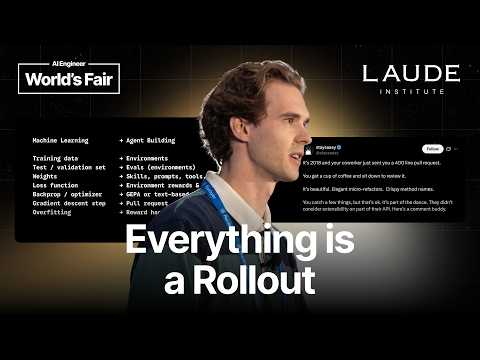
Alex Shaw and Ryan Marten present a rollout-centered view of evaluating and improving AI agents. Drawing on their work on Harbor, Terminal-Bench, and OpenThoughts-Agent, they connect sandboxed environments, agent evaluations, and optimization workflows into a practical framework for generating and learning from rollouts. Speakers: Alex Shaw — Member of Technical Staff, Laude Institute Alex is the creator of Harbor, a framework for evaluating and optimizing agents and language models in sandboxed environments. https://www.linkedin.com/in/alexgshaw/ Ryan Marten — Member of Technical Staff, La
04

Across a dozen eval jobs Arize watches the top teams run, one pattern holds: the eval has to change as fast as the agent it grades. In 2023 an agent was barely more than a prompt; since then reasoning, tool calls, and long multi step loops piled on, and every jump in capability quietly broke the eval that came before. So the evals evolved with them. Deterministic checks catch what you can define up front, LLM as a judge adds the analysis a fixed rule cannot, and the newest step, agent as a judge, hunts for failure modes you would never think to write a check for and can open a pull request to
05

Instead of getting paged at midnight and starting to dig, you wake up to an issue that has already been investigated: the traces pulled, the root cause found, and a pull request with the fix waiting for review. That is what Arize built with Signal, and Jason Lopatecki walks through the anatomy of it. The unlock is boring and specific: traces on a filesystem. A skill pulls the relevant production traces and logs down as files into the repo, right next to the code, sometimes ten megabytes of them, because coding harnesses like Claude Code are magical with files and hopeless with a dashboard. Fr
06

Model Whisperers How Evals and Prompts Shape Agent Behavior — Preetika Bhateja & Daniel Bump, Google
Getting an AI agent to behave the way you want isn't just about writing better prompts. In real systems, behavior emerges from a loop: prompts, evals, iteration, and feedback. Small changes in any part of that loop can completely change outcomes. The Google team shares lessons from building a seed-asset agent that turns messy advertising creatives — low-quality images, cluttered visuals, and heavy text overlays — into clean, reusable assets for downstream generative AI tools. They explain why prompting alone did not produce stable behavior, how evals became feedback signals rather than scorec
07

This talk covers how Uber designed evals for its food enhancement agent, which edits food photography to better present dishes for smaller, independent Uber Eats merchants, along with the pitfalls and lessons learned along the way. The problem is uniquely hard: the system must stay faithful to the original dish, preserve each merchant's brand and packaging, and avoid homogenizing the marketplace, all without an existing playbook for multimodal evals in a narrow domain. Soumya Gupta and Jai Chopra explain how they navigated reward hacking, built a closed feedback loop combining offline and onl
08

A generated clip where the character stands frozen for four seconds can still score well, because the judge rewarded the gloss and the vibe instead of what actually happened. That failure is the whole problem with evaling video: CLIP score misses temporal incoherence, a team watching clips on Friday does not scale, and any AI judge you wire up drifts from human preference unless you measure the drift. Video breaks the text playbook because it has to hold temporal consistency, shot continuity, and a coherent story across frames, not just look good in a single still. The fix that stuck was to s
09
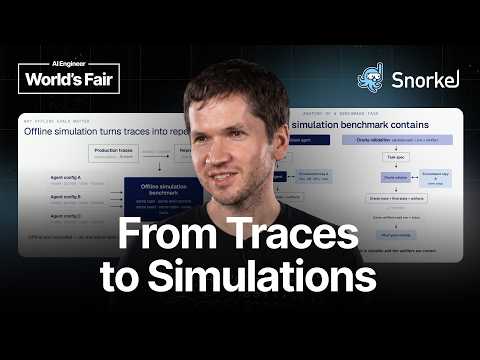
Take a real production trace, rebuild the database state, tools, and files the agent touched, and you have a task any model can replay under identical conditions. That reconstruction is the move at the center of this talk. Public benchmarks like WebArena hand you a single success rate on someone else's tasks, but what you actually care about is cost per solved task, latency, and whether the agent followed your policies. So you build a private benchmark from your own traces, wire in the same skills, tools, and evaluators the agent sees in production, and compare models apples to apples on the e
10

11

The constraint on edge AI is not compute, it is RAM, and it is getting worse: phone makers are shipping less of it this year, and a 6GB Raspberry Pi costs 2.5 times what it did at launch. So Cormac Brick's team at Google AI Edge spends its effort making models small enough to fit. A 2 billion parameter Gemma, quantized to 2.9 bits per weight, runs on a Raspberry Pi at about 8 tokens per second and on a Qualcomm NPU fast enough for a few frames of vision a second. Below that sit tiny models, from 500 million parameters down to 50, that reach the older laptops and cheap devices where even a sma
12

Full episode: https://www.youtube.com/watch?v=OS1NZLgKM2c Me on twitter: https://x.com/dwarkesh_sp
07
Papers
01
GS-Agent针对自然语言描述生成动态物理真实的4D世界这一耗时繁琐的手工设计问题,采用多智能体框架与物理引擎闭环,模仿人类制作流程拆解成实体管理、资产挑选、材质调节、运动与渲染控制,迭代交互实现物理可行、可控的4D场景。其能快速产出含液体、柔体、刚体互动与摄像机灯光的真实感动画,适合想用AI驱动创作与物理仿真并行的 Agent 产品工程者。
02
解决了并发态态 Rust API 调试中 LLM 生成的测试常因缺乏前置条件和并发深度而失效的问题;方法是用色彩 Petri‐Net 先建模资源、 生命周期和因果;从中抽取合法/近合法/部分顺序场景,再以它们作为约束交给 LLM,配合本地可靠性契约与结构修复循环保证意图完整;因为它在保持 LLM 高效性的同时,显著提升了并发覆盖率与错误定位,适合 Agent/AI 产品工程师快速产出安全、可维护的 Rust 测试。
03
在百万‑token上下文里,现有 Multi‑Token‑Prediction(MTP)草稿头需对全 KV 做 attention,成本随上下文线性增长,导致本应加速的草稿效益消失。作者提出 Windowed‑MTP:给草稿 attention 加滑动窗口和 attention sink,只保留మహా KV 的固定比例,训练无改动,仍保持原目标的确认分布。实验表明在 Qwen、Mamba Hat 等三大体系单 GPU 1M 文本下,草稿成本可削减 28–44%,端到端解码延时同步提升,且质量无损,极适合需要大上下文推理的 Agent/LLM 产品。
04
大规模音频‑语言模型在听觉感知上已卓有成效,却因腔缺乏高质量音频推理数据,在逻辑推理方面仍落后于文本模型。X$^3$-OPD 通过跨模态 on‑policy distillation,利用文本教师的 chain‑of‑thought discontinued,由学生在其自身的声感知基础上生成推理轨迹,并以 token‑level 指导,构建覆盖语音化文本推理、复杂声景事件推理与语调情景 Movers 的三层对齐语料库,从而让音频模型拥有更稳健的推理与对话能力。对张玉璟关注 Agent/AI 产品工程的人员而言,该方法既能保持原有感知功底,又能以可解释的连锁思路提升音频交互与决策质量,值得快速扫阅。
05
MIRROR 解决视觉‑语言 implica4 论文的不同视角(文本、图像和混合)在几何推理上表现偏差的问题。它通过构建 ODA‑Data 做到对同一题目多视谱的齐全标注,然后用强化学习的逆 KL 目标,让成绩最好的视角“教师”指导其它视角。对需要多模态一致推理的 Agent 或智能助理来说,这能显著提升跨模态鲁棒性和解题准确率。
06
在复杂推理引擎(Claude Code、Codex、OpenClaw 等)支持的多轮工具交互中,端到端训练被高耦合的 harness 逻辑所阻挡。OpenForgeRL 通过轻量化的代理记录 harness 调用并在标准 RL 代码(如 veRL)中做监督学习,同时使用 Kubernetes 在独立容器中跑每一次 rollout,实现任何环境中任何 harness 的大规模训练。这个框架拆分训练与推理,使产品工程师能直接在真实 harness 与环境里微调、评估和提升代理行为,显著降低实验成本与平台依赖。
07
问题:使大型语言模型能在道德推理中既采纳合理观点又不盲目随从。方法:通过三项实验,把模型判断的变更量化为“视角距离”“观点来源”“联盟结构”三维度,比较各条件下的抵抗与合规。价值:为 Agent/AI 产品提供可操作的判断‑更新框架,明确区分建设性修正与媚俗顺从,帮助实现更稳健的社会化对话。
08
面向胶印的质检仍依赖慢速、昂贵且主观的人工检查,缺陷图像稀缺限制了深度学习模型的训练。本文提出一套零成本合成数据生成框架,自动化生成高保真缺陷图像及标注,并用 RFDETR 训练模型,最终在真实工业样本上达成 80.9% mAP。对于需要快速部署、高效缺陷检测的 Agent/AI 产品工程师而言,该方法既缩短验证周期,又能显著提升检测鲁棒性。
08
Issue Monitor
Ready now—Actionable issues
Needs review—Awaiting a fresh check
Data statusCheck statusLive status unavailable