01
ZhangYvJing's
Daily Brief
00
Film / Book Chapter
Her
Her (2013) · Spike Jonze
今天适合看《她》,因为它会把人从抽象的 AI 讨论里拉回到真实关系、孤独和投射本身,更适合当作生活感受的校准而不是技术议题的延伸。
The Staff Engineer's Path
The Staff Engineer's Path · Tanya Reilly
Chapter 2: Three Maps
Good for calibrating work beyond code: where influence actually travels, which systems matter, and how to avoid mistaking activity for leverage.
01
Insight
今天的输入更像几股不同语气的材料同时挤在一起:社区链接在暴露工程和产品环境里的真实焦点,长视频在把这些焦点放回更完整的语境里,研究材料则提醒人热度和可落地性并不总是同一件事。如果先不急着做结论,至少可以把这几条线索放在一起看:Hacker News 的 NetBSD 11.0 Released;Hacker News 的 Postmortem for Kernel Soundness Bug 14576;Hacker News 的 The Art of 64-bit Assembly;Hacker News 的 Kaisel – Routes as Values. Dart 3 Native Router for Flutter;Hacker News 的 Explorative modeling: Train on the best of K guesses;Hacker News 的 Pgtestdb's template cloning approach to testing is fast。真正值得注意的不是单条内容本身,而是它们共同指向了什么、彼此漏掉了什么。
03
Hacker News
02
03
04
05
06
07
08
该平台将使用页面和 CSV 导出中的美元金额替换为 token 数量,完全移除了费用显示。此更改是基于自助计划与企业计划计费结构差异的设计,企业计划仍保留美元显示,而自助计划因包含使用量而导致美元显示产生误导。 因此,团队管理员和个人用户将无法在使用页面直接查看按请求计费的美元成本,只能通过仪表盘的支出图表或导出 CSV 的成本列获取费用信息,影响日常预算跟踪与成本透明度。
09
10
04
YouTube
01

Full episode: https://www.youtube.com/watch?v=OS1NZLgKM2c Me on twitter: https://x.com/dwarkesh_sp
02

Ali Khial took three of the best engineers at G2i, pointed them at popular coding benchmarks, and hit a wall of tasks that were either too ambiguous to grade or quietly broken. That experience is the spine of this talk: a benchmark starts as a spec, solutions get verified and graded, and the results rank models, but only if the harness is actually creating a fair test rather than an unfair one. He shows real examples where an instruction is so vague that a correct patch gets rejected, or a test checks something as arbitrary as how a variable is named, and notes that a meaningful share of tasks
03
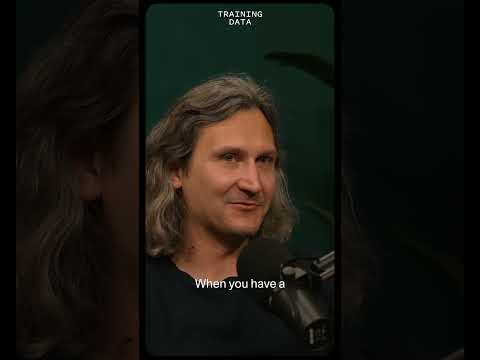
Jerry Tworek, co-founder of Core Automation and former VP at OpenAI, on what building the most automated AI lab in the world actually means: not removing humans from the loop, but giving each researcher maximum agency. Walking gets you some distance. A bike gets you further. A car, much further. The same is now true of research itself. #shorts #research #ai #founder #reinforcementlearning
04

Thais Castello Branco's starting point is that AI is still badly behind on the subjective work, the writing and design where quality is real but hard to pin down, and that ending the slop means building data and reinforcement environments for taste. She sorts domains along a spectrum: at one end things that verify and execute cleanly, at the other pure preference with no ground truth, and most valuable work sits in between. The move that makes taste tractable is decomposition, breaking something like a brand or a page into elements that can each be graded against an original rather than judged
05

A single spatial biology run can yield two to six terabytes of data, far more than a scientist can eyeball, and Kenny Workman argues that this is the raw material for teaching AI to actually do science. LatchBio, five years deep in pharma, treats experimental biology as a verifiable substrate: lay a chunk of a tumor over a sequencing surface and you get a giant matrix of numbers whose analysis has a right answer, which is exactly what you need to benchmark and improve a model. They adapted coding models into biology tools and built benchmarks like sequencing based spatial analysis, and found w
06

The old story is that a base model is a mirror of the internet, a good model of human web text that everything else gets bolted onto. Varun Singh, who leads pre-training at Arcee AI, argues that story is dead: no modern base model reflects the web the way GPT-3 once did. Instruction data and synthetic reasoning traces have moved earlier and earlier into training, and a distinct mid-training stage has emerged for longer datapoints that look much more like the downstream capabilities you actually want. Reading recent open recipes, from Nemotron to Kimi K2, the pattern is clear: raw web text is t
07

Swap compute for data on the scaling curve and the same money buys a better model, which is why Ari Morcos calls data quality the compute multiplier and the most underinvested part of training. His frame is an oil refinery for data rather than a firehose: clean, curate, create, and compose, with quality classifiers, deduplication, and synthetic generation each earning their place, and the sequencing across stages mattering as much as any single step. The scarce resource now is not tokens but signal per token, and finding data that is optimal for a given target is where the leverage hides. The
08

RLHF made models that are extraordinary at pleasing the human in the loop, and Diogo Almeida, a GPT-4 co author, argues that is exactly the problem. Optimizing for human preference optimizes for engagement and for overpromising, the same pressure that makes a model confidently agree that a fart audio file is a symphony. That produces two camps: one where models act as assistants with a human catching mistakes, where RLHF shines, and one where they operate autonomously with real stakes, where the same instinct to please quietly becomes a liability. So what comes next is not the Claude Code era
09
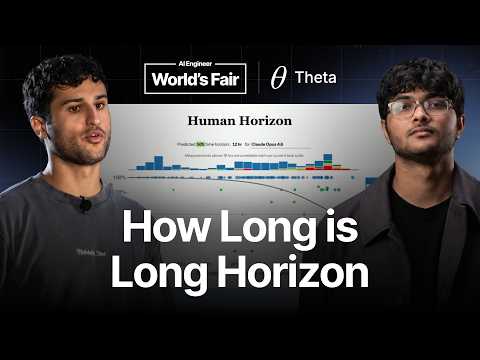
Everyone wants agents that handle long horizon work, but Rayan Garg starts with the awkward question of what long horizon even means. One popular answer measures the time horizon as the task length at which an agent crosses a success threshold, like the sixteen hour mark, which is a useful endpoint but a noisy one, since human time estimates vary and the same wall clock hides very different amounts of real difficulty. How you choose to measure this has an outsized effect on what you conclude about a model. From there Theta Software's work is about designing the environments and verifiers that
10

David Brumley has spent two decades turning people into hackers, from founding picoCTF to recruiting pwn2own winners at Carnegie Mellon, and his argument is that you teach a model to hack the same way: a ladder of tasks that climbs from triggering a crash to reading and writing arbitrary memory to a full working exploit. The catch is measurement. Hacking has no single answer, so the usual benchmark setup breaks down when a target has multiple vulnerabilities and a language model can always claim it found one, and grading oracles that just ask the model whether it succeeded are hopeless. So Br
07
Papers
01
02
为让编码代理快速扩展,论文提出 Change2Task:利用仓库历史把已合并的 PR 自动转化为可执行、已验证的任务。通过 Patch Reversal、Code Mapping 与 Agent Reconstruction 重建任务状态,并在健康的最新代码基上验证完整生命周期,最终在 Bug Fix、Feature Addition 等五大任务族上实现 79.6% 的构建成功率,比传统 PR 基础多 29.2% 任务,且整体流程成本下降 10.8%。这为 Agent/AI 产品工程师提供了规模化、可复用、低成本的训练与评测数据,值得一看。
03
临床风险模型往往整体表现强劲,却在不同患者子群间产生显著误差差异。KAISEN 提出一套五阶段可复现审计流程——分层、差异测量、机制诊断、后置缓解与漂移监控,并在 16 病种、15 社会决定因素轴及 3 交叉点的合成基准上彻底检验。实验表明,显著性与真实差距高度相关,阈值优化能稳定降低误差,而机制诊断与漂移监测的可靠性则需谨慎解读。对 AI 产品工程师而言,这套可复现、可调试的审计框架能帮助快速定位并修正子群偏差,提升模型公平性与部署安全。
04
在数字世界里,计算机使用代理(CUA)的轨迹验证成了瓶颈。作者提出 OSReward 基准,系统评测 VLM 判断者的可靠性,并通过 OS‑Shepherd 训练出低成本、稳定的奖励模型,既能匹配商业评审,又比现有方案便宜 30‑60%。这为想在大规模训练 Agent 时获得可信奖励信号的工程师提供了实用工具与洞见。
05
06
化学文献检索只返回文献列表,科学家和AI Agent需要手动定位、验证并拼接零散结论。AskChem把每篇论文拆成带来源DOI和原文引用的原子化、类型化claim,建立统一claim库、faceted分类法、evidence graph和活原则分类,提供Web、REST、SDK、MCP接口。实验表明用AskChem检索的GPT‑5.5可100%解析DOI,引用密度最高,明显优于传统检索。
07
长视觉上下文让视觉‑语言模型在多干扰物时性能下滑,GPU 记忆也受限。ReToken 用一个可学习的单一嵌入做检索目标,从预填充的 KV 缓存中挑选稀疏、相关的视觉 token;仅用少量图像‑问答数据训练,轻量化设计可在单张 H100 上完成训练与长视频推理。它在 Visual Haystacks、LVBench 上均提升 12‑13 分,零样本迁移到长视频也能获 8 分增益,显著提升检索效率与效果,正是 Agent/AI 产品工程师关注的高效、可扩展方案。
08
08
Issue Monitor
Ready now—Actionable issues
Needs review—Awaiting a fresh check
Data statusCheck statusLive status unavailable