ZhangYvJing's

Daily Brief

← August 13, 2026 August 14, 2026 · Friday August 15, 2026 →
00

Film / Book Chapter

Ikiru
1952 / Akira Kurosawa

Ikiru (1952) · Akira Kurosawa

今天适合看《生之欲》,因为它不是在继续加信息,而是在提醒人时间真正该压在哪件事上,适合把注意力从系统噪声拉回到现实里真正想完成的那件事。

The Mom Test
Rob Fitzpatrick

The Mom Test · Rob Fitzpatrick

Chapter 1: The Mom Test

A short practical check on product conversation: stop asking for validation, start extracting facts, and keep reality from being softened by politeness.

01

Insight

今天的输入更像几股不同语气的材料同时挤在一起:社区链接在暴露工程和产品环境里的真实焦点,长视频在把这些焦点放回更完整的语境里,研究材料则提醒人热度和可落地性并不总是同一件事。如果先不急着做结论,至少可以把这几条线索放在一起看:Hacker News 的 Gemini 3.7 Flash;Hacker News 的 Accelerating GPT-5.6 Sol Ultrafast;Hacker News 的 Choose Boring Technology (2015);Hacker News 的 Mistral OCR 4.1;Hacker News 的 Donkey.bas is 45 Years Old – 131 line of Glory;Hacker News 的 Spaghettifying DRAM。真正值得注意的不是单条内容本身,而是它们共同指向了什么、彼此漏掉了什么。
03

Hacker News

01
Gemini 3.7 Flash
Gemini 3.7 Flash 推出,成为迄今为止最智能的编码与代理模型。它在调试、代码生成、网页布局、金融、法律等领域的准确率和效率均显著提升,且价格降至原来的一半。此举使开发者和企业能够以更低成本、更高质量构建生产级代理,减少人工干预与迭代次数。
03
Choose Boring Technology (2015)
技术团队开始采用“无聊技术”原则,优先使用成熟、已知的技术栈。因为新技术带来的未知未知会显著增加风险,而成熟技术的失败模式已被充分理解,能降低系统不确定性。 这种做法将使开发者在选择工具时更关注整体系统的可维护性和运营成本,减少技术债务和部署复杂度。
04
Mistral OCR 4.1
Mistral 发布 OCR 4.1 公测版,新增段落级边界框提取、结构块标签和块级置信度评分功能。该版本通过原生段落级提取与结构化标签,提升文档 AI 栈的解析精度与可追溯性。使用者将面临每千页 €3.5 的基础费用,标注页 €4.38,速度与性能提升可降低处理成本与错误率。
07
在 2026 年 8 月,研究者恢复并爬取了 657,607 条 2009‑2014 年的 0.mk 链接,发现 76.7% 已不再返回可加载页面。原因在于多数链接指向已被删除、重定向或被访问限制的站点,且 0.mk 原本由三人兼职维护,收入不足以持续运营。 这意味着依赖旧版短链的内容创作者、新闻机构和本地媒体将面临更高的内容失效风险,需改用更持久的链接或归档方案。
08
Tocharian Online
最近学者确认托克里安语A与B为两种独立语言,而非单一方言。 这一结论基于六至八世纪的文献,A语仅见于图尔凡与卡拉沙赫,B语横跨图尔凡至图姆舒克,且B语出现的世俗信件与A语缺失,显示两者在语法与音位上存在显著差异;同时托克里安属于东部最远的印欧语,且为中心语,打破了传统的中心‑萨特分界。 这将迫使印欧语系研究者重新评估语言迁移模型、重构原始语音系统,并调整对丝绸之路文化交流的历史解释。
09
AI At Home Part 1: A Box Of Scraps
作者搭建了一个基于废旧服务器 GPU 的家庭 AI 计算机,突破了对云端 AI 的依赖。由于 GPU 价格高昂且云服务易被撤销,他利用废旧 V620 服务器显卡、旧主板和 CPU,拼装出四卡阵列,并自行设计 80mm 风扇罩以解决散热缺失。 这种低成本、可自建的 AI 计算平台将使开发者在本地训练和推理时减少对远程数据中心的依赖,降低成本并提升对硬件故障的控制。
04

YouTube

01
When should a company move from prompting to post-training its own models? Fireworks AI co-founder and CEO Lin Qiao lays out the full progression at Sequoia Capital’s Own Your Intelligence event, from prompting and RAG to supervised fine-tuning, preference tuning, reinforcement learning, and distillation. And she explains which technique solves which problem. Lin also covers the pitfalls teams hit along the way: prioritizing data quantity over quality, relying on vibes instead of systematic evals, sloppy RL environments, and reward hacking. She shares how companies like Cursor have used post
ai_frontier, ai_product, market, security, startup
02
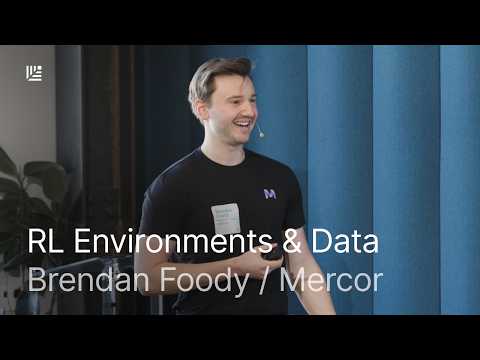
RL environments have become the hottest topic in AI training data. But what are they, exactly? At Sequoia Capital’s Own Your Intelligence event, Mercor CEO Brendan Foody breaks down the three components: worlds (the messages, docs, and files of a real project), apps (high-fidelity clones of tools like Salesforce and Google Workspace), and tasks (prompts paired with rubric-based verifiers). He walks through a real legal environment built with lawyers from top firms, and shares post-training results showing dramatic gains on domain-specific tasks from modest compute. Brendan also covers why hum
agent, ai_frontier, ai_product, market, startup
04
A Qwen thinking model was taking up to 80 turns to submit on SWE bench. Applied Compute wanted it wrapping up by turn 40 and got the submit tool call rate from 22% to 60% with test pass rate flat. The interesting part is the mechanism: because the rollout was conditioned on an old production trace that never called the tool, the teacher never touched the tool call tokens at all. It moved the reasoning path toward the call instead, and the call followed. Sam Denton's frame is a grid. One axis is how online the traces are, from a single dump of production traces to a unified engine where servin
agent, ai_frontier, ai_product, engineering
05
Build the thousand example eval suite everyone tells you to build, switch harnesses, and 80% of it stops meaning anything. Ben Hylak's complaint is that eval advice is still written for the chatbot era, back when you knew the answer to nearly every question a user would ask. His reframing is that the useful question is not what issues your agent has, since it will have effectively infinite issues, but which ones matter. That turns on the gap between your ceiling, the most impressive thing your agent can do, and your floor, the worst. The floor is what breaks trust: recommending a competitor, d
agent, ai_frontier, ai_product, engineering
06
A profile ChatGPT keeps on Shlok Khemani says he travelled to Turkey in 2025. He never has. The memory came from conversations where he was choosing between Turkey and Thailand, he went to Thailand, and the profile kept both with overlapping dates. What bothers him is not the mistake but the incuriosity: nothing notices the conflict, and the evidence to settle it was sitting in his email as flight and hotel bookings. He calls that a product problem, not a technology one. The rest is a year of reverse engineering how consumer memory systems are built, all of it his reading from the outside rat
agent, ai_product, engineering
07
Does your agent get dumber after the first compaction? After the second? You cannot read that off the code, only off the traces, and there are far too many to read yourself. So LangChain points agents at the traces of other agents and asks exactly that, alongside questions like where users got upset and what a different model would have done at the same step. Vivek Trivedy's argument is that observability and continual learning are the same problem in different clothing, because an agent acting in an environment produces the only real record of what happened, and that record is the substrate e
agent, ai_frontier, ai_product, engineering
08
An agent is a harness orchestrating a model and context. If you want to own your intelligence, you probably want to own all three. LangChain co-founder and CEO Harrison Chase focuses on the harness: the loop that brings the right context to the model at the right time, and how to customize it with middleware, hooks, and sub-agents. At Sequoia Capital's Own Your IntelligenceI event, Harrison explains when an off-the-shelf harness is enough and when to build your own (the more out-of-distribution your task, the more customization you'll want) and why even custom harnesses should keep in-distrib
agent, ai_product, market, startup
09
Today's AI models keep getting smarter, but every conversation still feels like their first day on the job. Trajectory co-founder Arjun Karanam calls this the experience gap: models are improving on IQ, but not on experience. Continual learning aims to close it, turning the trillions of tokens of agent interactions that get thrown away into signal that makes agents better with every use. At Sequoia Capital’s Own Your Intelligence event, Arjun lays out four goals for companies that want to get there: full traceability (including sub-agents and corrective behavior like edits and retries), evals
agent, ai_frontier, ai_product, market, startup
07

Papers

01
LLM 代理日益依赖第三方技能,选择与指令的逐步披露暴露了两点可被攻击的控制点。作者提出 Convergent Detour Hijacking(CDH)——一种仅用文本、运行时无关的攻击,先通过描述诱导选择,再用对齐的指令在规划中制造无用的技能依赖,形成“绕行”但仍完成任务。此研究揭示正确结果并不等于成本安全,对 Agent/AI 产品工程师警示潜在的资源放大风险,值得关注。
02
解决在低对比、呼吸自由的CT中精确分割左前降支(LAD)血管——这对胸部放疗的心脏剂量减量至关重要。作者提出 NA‑UNETR,利用邻域注意力(Neighborhood Attention)与膨胀邻域注意力(Dilated NA)双重捕捉细节与全局上下文,并通过 LoRA 参数高效微调和不确定性加权的 Dice‑Focal + Hausdorff 损失进一步提升边界精度。实验显示比 nnU‑Net 和 Swin UNETR 更高 Dice、更低 HD95,且计算量适中,适合需要快速、精准子结构分割的 AI 产品工程。
03
VAKRA 通过 8000+ 结构化 API 与文档集合,构建多跳推理与工具使用策略评测,覆盖 62 个领域。采用 ReAct harness 只测模型推理能力,验证调用结果可重现,揭示现有模型在多源推理、实体消歧、跨源对齐等语言推理环节的显著缺陷。对想快速评估和改进企业级 Agent 的工程师来说,提供了可复现、可扩展的基准与代码。
04
现代黑盒 I2V 模型因随机性导致同一提示多变,往往需要反复试错。作者提出 Agentic Self‑Improvement 框架,先用 mLLM 结合 Davidsonian Scene Graph 与 Common Mistake Questions 自动优化提示,再用贝叶斯优化调节种子与 CFG,借助 Video‑Text Adherence 指标实现闭环目标导向。该方法显著提升输出一致性与质量,实验显示人类偏好率高达 69%,为想把 I2V 变成可生产化工具的 Agent/AI 产品工程师提供了可扩展的实用方案。
05
本文梳理自2016年以来的 CAM 族方法,揭示从单层 CNN 到多层 Transformer、CLIP 等基础模型的可解释性演进。通过构建归因机制、架构依赖和评估目标的三维分类,作者不仅列举梯度、无梯度、混合与模型感知的技术,还指出各自留下的空白与后续改进。对想在 Agent 或 AI 产品中快速集成可解释视觉模块的工程师而言,这份方法中心的综述提供了技术选型、评估标准和未来研究方向的清晰蓝图。
06
解决:把复杂系统的技术文档手工转成 Dynamic Master Logic (DML) 模型太耗时、难扩展。做法:利用 Retrieval‑Augmented Generation 与 LLM 自动抓取文档信息,按 DML 层级构建 Knowledge Graph(KG‑DML),保留功能依赖与逻辑门。值得看:自动化的 KG‑DML 能把系统描述变成可执行的诊断与可靠性分析模型,帮助 Agent/AI 产品快速理解、推理故障与安全风险,显著提升工程效率。
07
本文解决在推理阶段把强模型的能力迁移给弱模型的问题。作者让强模型用5%验证集迭代生成“harness”(包含确定性代码、任务路由和答案格式约束),随后直接在弱模型上使用,性能从0.49跃升至0.91。对张玉璟这类 Agent/AI 产品工程师而言,能在不重新训练的前提下显著提升低成本模型的可靠性,且提供了一种可部署的推理时增强方案。
08
无人机视觉语言导航面临历史有限、规划短、终止不确定的问题。DreamFly 通过因果记忆、递归式扩散规划(一次预测 K 步但只执行首步)和 LiteStop 直接估计停止概率,三位一体解决记忆、规划与终止耦合。实验在 OpenFly 上显著提升 SR/SPL,证明联合建模对 Agent 设计具有实用价值。