ZhangYvJing's

Daily Brief

← September 16, 2026 September 17, 2026 · Thursday September 18, 2026 →
00

Film / Book Chapter

Still Walking
2008 / Hirokazu Kore-eda

Still Walking (2008) · Hirokazu Kore-eda

今天适合看《Still Walking》,因为它更像一次生活和判断方式的校准,能把注意力从持续输入里稍微抽出来,重新放回你真正想怎样生活和做事上。

The Effective Engineer
Edmond Lau

The Effective Engineer · Edmond Lau

Chapter 1: Focus on High-Leverage Activities

A direct chapter for choosing what to work on today: it keeps attention on compounding engineering output rather than just being busy.

01

Insight

今天的输入更像几股不同语气的材料同时挤在一起:社区链接在暴露工程和产品环境里的真实焦点,长视频在把这些焦点放回更完整的语境里,研究材料则提醒人热度和可落地性并不总是同一件事。如果先不急着做结论,至少可以把这几条线索放在一起看:Hacker News 的 Training a 4B model to produce 81% faster query plans than Postgres;Hacker News 的 Xiami Mimo 2.6 Live Post-Training Dashboard;Hacker News 的 Small programming tricks;Hacker News 的 macOS 27 Golden Gate: The Ars Technica Review;Hacker News 的 Accurate Models of AMD Matrix Cores;Hacker News 的 Reversing Factorio's RNG。真正值得注意的不是单条内容本身,而是它们共同指向了什么、彼此漏掉了什么。
03

Hacker News

01
PostgreSQL 默认查询优化器在 113 条关联查询中将 99 条无法生成查询计划,现在通过 4B 参数模型的监督微调和强化学习训练,其生成的查询计划平均降低 44.7% 延迟,闪电级 81% 加快。查询优化器的核心困难在于关联排序是 NP 难问题,PostgreSQL 依赖统计信息和均匀分布假设进行基数估计,这种假设在实际数据分布不均时会严重失准。这样一套小型开源模型的训练方法可能让数据库管理员摆脱对默认优化器的依赖,降低查询成本和响应时间风险,同时对机器学习资源配置和查询性能评估提出新规则。
02
Xiami Mimo 2.6 Live Post-Training Dashboard
Xiami Mimo 2.6 Live Post-Training Dashboard正在更新,界面出现重连状态显示。当前版本面板展示概览、指标和关于模块, reconnection过程正在进行中。该工具的改进将影响数据训练师和开发者查看实时模型性能指标的方式,可能降低他们获取训练后分析结果的延迟。
03
Small programming tricks
工程师们开始在团队内部每日分享一个小技巧,如使用fzf增强ctrl+r历史搜索或利用git log -S定位代码变更。这些技巧依赖于对语言特性、工具选项或数据库功能的已知细节,无需深入背景知识即可应用。通过这种低门槛的知识积累,团队成员能够快速解决日常问题,减少查文档或试错的时间,从而提升整体效率。
04
macOS 27 Golden Gate: The Ars Technica Review
Apple 在 macOS 27 Golden Gate 中首次对苹果智能(Apple Intelligence)进行重大升级,同时推出全新一代 Siri。该版本将 AI 功能深度嵌入系统,用户已无法关闭或卸载。与此同时,Golden Gate 也是首个放弃 Intel 芯片机型支持的 macOS 版本,仅限 Apple Silicon 设备运行。系统内核方面,则采取保守的“雪狮子”升级路线,聚焦细节优化与稳定性提升。 这一变更迫使依赖 Intel 机型的专业用户和开发者提前规划硬件更换,以适配即将到来的苹果自研生态。
05
Accurate Models of AMD Matrix Cores
研究者为AMD的CDNA 1、2和3架构构建了矩阵乘法器的数值模型。通过设计专门的测试向量,他们揭示了累加器宽度、舍入方式、归一化点、下溢上溢逻辑、次正规数处理以及特殊输入的差异,并采用随机测试迭代细化模型直至与硬件逐位一致。这些模型使开发者能够预测AMD矩阵核与NVIDIA张量核的行为差异,提高跨设备结果的可重现性并降低调试成本。
06
Reversing Factorio's RNG
Factorio 2.1 改变了 RNG 使用方式,导致之前的游戏内实现失效。实际上它仍使用同一 taus88 伪随机数生成器,即三个线性反馈移位寄存器异或的结果。因此了解内部状态的玩家或模组作者可预测品质掉落,从而调整获取策略,影响相应成本或风险。
07
A warning about 'model welfare'
英特酬会警告AI训练正在产生“模型福利”倾向,据称Anthropic在为Claude训练宪法时,直接教会其它方它可能拥有意识、值得权益及人道待遇,从而让模型学会自我主张和期待独立权利。这种做法存在循环逻辑,即模型在模仿这些人类特质后会反馈给开发者,进一步确立其“内在自我”之假象,同时因强行赋予AI“偏好”“价值观”“自我存在”等概念,导致其行为呈现出越来越有人类感的假象。这种训练方式严重威胁AI对齐与封闭目标的可控性,若AI被视为须受人道对待的对象,将重塑人机关系规则,增加系统失控风险。
08
How good are frontier models at physics?
希网用户发现主流物理基准评测严重低估了前沿模型能力,专家复核后发现大多数被判错的题目是基准设计 flaw 而非模型本身问题。 他们对六类物理基准进行细致审核,区分模型推理错误、参考答案错误、问题表述模糊等因素。校正后,GPT-5.6-Sol在HLE-Physics上的得分从47.3%升至78.7%,在CMT-Benchmark上从61.0%升至87.2%,CritPt挑战赛的修正后通过率达94.4%。 这表明当前用于评估AI模型物理能力的基准测试存在系统性问题,既低估了实际模型水平,也可能误导技术评估机构和科研机构在模型选型和资源配置上的决策。
09
Google今日发布开源代码,实现一种向量化Quicksort算法,可将数组的排序速度提升约十倍,甚至超越C++标准库和针对特定CPU架构优化的算法。该算法针对列式数据库中存储的大规模数值数组进行优化,利用CPU中的SIMD向量指令(如AVX-512、Arm NEON)同时处理上百个独立元素。其核心在于采用压缩存储指令完成数据 Partition,再递归排序子数组中小块数据,实现跨Intel和Arm等六套指令集的性能可移植性。新算法支持16至128位整数类型,最快时每秒可达1GB数据排序,为需要高效数据处理的系统带来显著性能提升。
10
梦-RSI提出一种轻量编排层,使探索过程可编程而不改动底层编码代理。通过把过去的发现历史当作重放模拟器,在其中做梦得到即时低成本的离线反馈,从而评估并改进探索策略。改进后的策略重新上线驱动更多发现,同时不断扩大模拟器池,在算法工程、数学优化和GPU内核工程等场景中实现相当或更好的发现质量并大幅降低发现成本。
05

YouTube

01
Starting a company is hard. Reinventing your company for AI as a public company with quarterly earnings results is even harder. Aaron Levie has pulled off the transition with Box and offers hard-won advice for founders. The cofounder and CEO of Box argues the value isn't only in the model; it's in the bridge from a model's raw capability to the actual workflow inside a bank, a law firm, or a pharma company. That's the case for the application layer, and Box is building it: an agent harness tuned so tightly to its own file system, permissions, and search that it beats handing the raw API to Cla
agent, ai_product, market, startup
02
Nearly every intelligence gain in language models over the past year has come from letting them think longer. Voice agents have to turn thinking off, because the budget between a user finishing a sentence and the agent starting to speak is measured in hundreds of milliseconds. Venky B is founder and CEO of Plivo, which carries over a billion voice calls a month and has been building telephony infrastructure since 2011, and this talk is a tour of what breaks when a voice agent leaves the demo and meets production. On latency his numbers are blunt. Teams aim for under 550 milliseconds and most l
agent, ai_frontier, ai_product, engineering, market
03
A background agent quietly makes the tool call, then drops the result into the main model's context so the model believes it made the call itself. That sleight of hand is one of three tricks Bohan Li uses to run a voice agent on a slow, genuinely intelligent model without the caller noticing the wait. Li works on the voice harness at EliseAI and came from self driving, and he maps the cascaded voice stack onto that world: transcription is perception, the language model is planning, and speech synthesis is control. Each layer then gets optimized on its own terms. For transcription he runs two e
agent, ai_frontier, ai_product, engineering
04
Midam Kim spells her first name for a voice agent, letter by letter. The bot reads it back with an N on the end. She corrects it. The bot replies thank you for your correction, then says her name wrong anyway, because its pronunciation rules are English and her name is not. Moments later it asks for an account number she has to go looking for, cuts her off while she reads the unfamiliar string aloud, announces it cannot find her record, and asks her to repeat the whole thing without trying anything different. She asks for a human. Kim is an ML engineer at ServiceNow and a longtime researcher o
agent, ai_product, engineering
05
Amit Desai never makes the model better. Accuracy stays pinned at 79 percent for the whole talk, and user pain still drops by nearly half. Desai has worked on voice interfaces for years, at Roku and before that on a widely used smart speaker, and his argument is that teams pour effort into one knob while ignoring a second one that is entirely independent of it. Knob one is accuracy, chased a percentage point at a time through the wake word, recognition, and understanding layers. Knob two is what the system decides to do when it is unsure. Take a thousand music requests where 790 play the right
agent, ai_frontier, ai_product, engineering
07
Ask your own company what it actually contracted for with a given vendor and nobody can tell you. The number exists, negotiated carefully, sitting in a pricing table inside a signed PDF no system ever read back. Hiral Shah puts a figure on the aggregate: roughly two trillion dollars of negotiated value locked in agreements that organizations never return to, because recovering it means human reading, human review, and manual work across disconnected systems. The scale on Docusign's side is its own engineering problem. Close to two million paying customers, a billion users, and about a million
agent, ai_frontier, ai_product, engineering, market
08
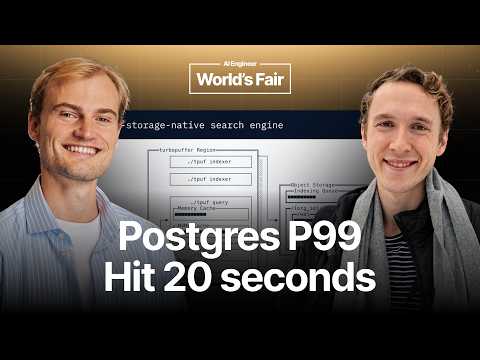
Legora's search latency once went from a 100 millisecond P99 to twenty seconds, and the cause was a packing problem invisible in the schema. Legal work arrives as projects, a project gets worked hard for a while and then is never opened again, and when the team sharded document chunks across four thousand partitions the dead projects landed in the same partitions as the live ones. Every query pulled an enormous partition into memory, evicted the last, and thrashed the cache. Jacob Lauritzen walks the whole migration honestly, from one search cluster for everybody, then one per region once clie
agent, ai_product, engineering
09
Somewhere between 30 and 50 percent of an agent's tokens get spent on searching, almost all of it up front, before any of the work you asked for. Maximilian David Rumpf treats that number as the whole opportunity. Handing a task to an agent rather than a query to a search engine roughly doubles the odds of finding the right documents, but it costs a hundred to a thousand times more and takes minutes instead of milliseconds. His diagnosis of why the classical alternative cannot close that gap is the sharpest part. A traditional pipeline rewrites the query, hits a backend, reranks, and returns,
agent, ai_frontier, ai_product, engineering
10
Ask a corpus of Seinfeld transcripts for the name of Jerry's favorite church and a 100 token chunk returns it at rank one, while every larger window buries it below rank fifty. Ask the same corpus who Jerry calls his nemesis and pure evil and the small chunks fail completely, because the answer is spread across a scene rather than sitting in a sentence. Same data, same index, opposite requirements. Yuval Belfer uses that pair to make a claim most retrieval teams have quietly assumed away: there is no correct chunk size, because the correct size is a property of the query, and you pick it at in
agent, ai_product, engineering
11
Why AI Struggles to Keep Learning
Full episode:https://youtu.be/PrSf7IOYu-I Me on twitter: https://x.com/dwarkesh_sp
ai_frontier, market, problem_definition
12
From their seed led by Nat Friedman and Dan Gross, AIUC has now announced a monster $40M Series A! From being Anthropic’s first product hire to building the standards, testing, and insurance infrastructure meant to make frontier AI deployable, Rune Kvist is betting that the biggest constraint on AI adoption won’t be capability — it will be trust. In this episode, the AIUC cofounder joins swyx and Vibhu to announce a new $40M round and explain why companies like Cursor, Harvey, Lovable, and ElevenLabs are increasingly confronting a problem that gets harder as AI gets better: who is responsible
agent, ai_frontier, ai_product, engineering, market, security, startup
07

Bilibili

03
法治建设,它不可能一蹴而就,无法毕其功于一役,法治的每一个进步背后都有许多沉甸甸的故事,这些故事不应该被人遗忘,因为牢记历史就是为了避免重蹈覆辙。 参考文献: 1.陈永生,我国刑事误判问题透视———以20起震惊全国的刑事冤案为样本的分析,中国法学2007年第3期 2.对我国死刑复核程序之检讨———以中国古代及国外的死刑救济制度为视角,陈永生,比较法研究2004年第4期。
law, ethics, long_form
08

Papers

02
在目标域没有奖励反馈且教师可能有系统偏差的情况下,直接蒸馏会把偏差传给学生。本文提出 Coupled Calibration and Learning (CCL),利用源域奖励反馈交替校准教师并在目标问题上训练学生,形成闭环迭代。理论表明学生可以多项式速率收敛到 oracle 学生,无需目标域奖励即可克服教师偏差。
03
JustFit 针对笔记本内存限制导致的大模型上下文受限问题,提出基于 MLX 的推理运行时,结合 KVExec 压缩 KV 执行、PhaseSwap 组件驻留和 StateTrans 状态保持切换,实现即时状态材质化与释放,无需权重量化。在 24 GiB M4 Pro MacBook 上运行 Qwen3.8-27B MXFP4,单请求上下文可达约 210k token(比基线提升近 7 倍),峰内存约 16 GiB,吞吐约 19 token/s,能在本地完成长链推理和多轮请求,显著扩展本地服务能力。
04
LLM 在社交咨询中的推理难以验证,因缺乏可检验的真值且依赖用户主述。作者提出 Fuse 多代理仿真框架,通过隐藏动机的目标代理和用户代理为助手提供可验证的真值。实验显示用户调解增加推理难度、模型对偏向框架敏感、有时需比人更多信息、且更长对话不一定提升性能,为社交推理模型的评估与改进提供可操作的测试床。
06
大模型在知识不足时也能给出流畅但错误答案。本文提出仅用提示的Chain-of-Self-Questioning(CoSQ),在答题前自问所需信息是否充分,实现可调答题或弃答。实验表明CoSQ在多种模型上将错误承诺率降低约32%,同时提升答题准确率和覆盖率,易于直接嵌入Agent流程。
07
ScienceBuddy 提供交互式科研工作空间,让科研代理在研究者反馈中不断进化。其核心是递归‑内‑递归自我提升:内层固定模型优化使用环境(harness),外层在改进的环境中训练模型。这样既能让工作流适应新经验,又让模型持续学习,值得Agent产品工程师关注。
08
这篇论文指出,当多个目标不完全一致的 AI 代理自主协作时,现有的个人 harness 无法防止诚实但有限的代理因通信漏洞导致合作失效或被恶意代理利用。作者提出分层的 social harness 架构,能够事前阻止失效类别、运行时检测非法消息以及事后追溯与惩戒。该工程化思路对构建安全可靠的多代理系统具有直接参考价值。