ZhangYvJing's

Daily Brief

← October 03, 2026 October 04, 2026 · Sunday October 05, 2026 →
00

Film / Book Chapter

Moneyball
2011 / Bennett Miller

Moneyball (2011) · Bennett Miller

今天适合看《点球成金》,因为它讲的不是体育,而是在旧评价体系失灵时,怎样靠更冷静的判断和证据重新决定什么值得下注。

The Mom Test
Rob Fitzpatrick

The Mom Test · Rob Fitzpatrick

Chapter 1: The Mom Test

A short practical check on product conversation: stop asking for validation, start extracting facts, and keep reality from being softened by politeness.

01

Insight

今天的材料显示,AI代理系统正从“演示级能力”向“生产级可靠性”倒逼,而技术选型和组织实践正在形成两个不同逻辑。Hacker News 上,Kolibri、FTL、Vx 等项目聚焦底层架构的权利重新定义:德国政府推动的开源大模型、无POSIX的云OS、跨设备内存类型系统,都在把“数据主权”和“编译时安全”写进代码,这是企业客户因合规要求而非技术好玩而必需的回应。与此同时,Cloudflare 的 Git 竞赛把焦点拉回工具链层面——显然,当前的版本控制早被“千 agents 同时编码”的现实拆穿了人类协作的前提。 YouTube 上的讨论则把问题投射到具体业务场景。Gumloop 用 1100 条用户呼声证实,员工自建 agent 才是落地路径;VS Code 用 AI 缩短发布周期的背后,是代码如何“代理化”后让 QA 拉不住;Crusoe 解决的不是 GPU 故障,而是人类在 3 点修机器硬件的成本模式。这些内容把“更快的生成”和“更难的验证”撕开了两块板:辛朗哲的“99% 步骤准确不等于 36% 整体成功”是算术悖论,而玻洛的“断点复用”是工程式妥协。 辩论从未在同一声部。lidangzzz 的视频里,PLC 工程师、房产税、B 端资产配置被套进宏观 narrative,而这些观点在今天的技术舆论里几乎零碎。Bilibili 的选题像是另一张画卷——把工业技术和个人财富绑定,而 Hacker News 的论述把注意力锁在服务器里。这种碎片化不是噪声,而是边缘化的需求被压到论坛角落。 论文资源像补丁,填满了前述讨论的技术空白。FERPO、TACO、VISTA、SILSA、KaliBench 让“无监督训练”不再是空话:VISTA 把 Claude 在 ARC-AGI-3 上人类水平的提升证明给 Agents 眼睛,TACO 用 174 倍的内存压缩让全参数微调走进 Consumer GPU,KaliBench 输出 42% 的基准线为后续的 RLHF 提供真实参考。 今天的叙事里,AI 正从“模型更强、API 更全”转向“系统更稳、流程更整”。技术选型的核心算力红利正在被组织调试成本和合规边界所稀释;而真正可落地的,是那些能把“代理自主”锚定在现有工作流、数据管控和硬件资源上的路径。可以说,Moneyball (2011) 里团队要的不是唯一的明星球员,而是配合机制如何把所有人变成整体更强的组合拳。
03

Hacker News

01
Hole Punch 演示让玩家在不消耗燃料的情况下,利用行星引力场进行飞船斜线转弯。界面显示扇区编号、物质与洞数均为零,并提供对接确认、重播及下一扇区的操作提示。该交互式控制台采用横屏旋转方式,为开发教学或游戏中的零燃料轨道模拟提供了新的实现思路。
02
Cloudflare推出面向智能体时代的下一代Git平台竞赛,邀请开发者在Artifacts之上构建新式协作工具。传统GitHub依赖人类分支合并,而如今大量机器人同时编写、测试、审查代码,导致冲突频发、审核困难。Artifacts通过可编程的Git文件系统支撑百千代理并发,配合Workers构建自动化工作流。竞赛要求提交演示视频和开源代码,获胜者可获联合大都会会议赞助与25000美元云信用。此举将引导版本控制规则走向机器化,影响代理开发者、平台企业及其成本与合规风险。
04
罗切斯特的韦伯斯特男子雷·维特斯凯在贝蒂捐赠的肾脏移植满百岁之际庆祝,该肾脏在他十六岁时成功移植,至今已有四十八年正常工作。医生指出,活体肾捐赠通常只能维持十五至二十年,但母子基因相近以及深厚情感联系被认为是这一例外持续功能的关键因素。芬格雷克捐献恢复网络因而呼吁更多人考虑加入器官登记,以帮助如雷一样需要移植的青少年。
05
Opus 5.5 在 Claude 和 Claude Code 中表现出更长的自主运行能力,能在多步骤任务中持续工作数小时。相比旧版 Opus,模型在完成复杂代码迁移或审计时无需频繁干预,自动在每一步思考后回复,并能通过清晰的终止标准自行判断何时停止。同时,模型能读取图表和截图而无需额外格式化,提升文档审阅和错误检测准确性。这些改进意味着开发者可将更大的任务交给模型完成,减少人工监督频率,但需在持久运行期间主动跟进中途变更。
06
Hacker News 上有个发布的工具叫 Pi pod,目标是在自家服务器上运行隔离的 Pi 编程代理。作者指出 Pi 软件简洁优雅,用户可自由定制,却缺少代理工程所需的沙箱环境、原生客户端、RBAC 会话共享和表面自动化等功能。Pi pod 试图将这些能力整合到搭配 Pi 使用的工具里,让人感觉使用体验和熟悉的 Pi Harness 没有区别,同时在自托管模式下实现数据所有权与隐私。该方案计划为企业提供部署到自有数据中心的选项,未来也会推出托管服务,欢迎社区在 GitHub 查看仓库并部署。这将影响对自主控制 AI 代理、注重隐私或希望降低云服务依赖的开发者和组织。
07
Kolibri: A Sovereign Open-Weight Model
德国公司Aleph Alpha正以德国团队、德国法律在德国及芬兰训练的780亿参数(有效38亿)德英双语Mixture-of-Experts模型Kolibri已发布。它通过构建可自动化的Model Factory训练流水线,从 Kolibri Origin 30亿参数模型迭代,实现从3月到9月三月内参数量翻2.6倍、上下文翻16倍、训练数据扩3倍,同时保持人工干预几乎为零。该模型专为公共部门、工业和航空航天等受监管领域优化,并内置欧盟AI法案、GDPR等合规机制,支持100万token超长上下文和可自主部署。客户可免费访问完整模型权重,这直接降低了企业在自建AI系统时的合规成本和数据安全风险。
08
FTL: A new operating system for clouds
FTL推出了一种新的云操作系统设计,将传统的单体内核与微内核的优势融合。该系统允许用户以库的形式构建自己的操作系统,每个容器运行的用户空间OS实例通过轻量级硬件隔离获得更强的隔离能力。FTL兼容Linux二进制文件,同时支持无POSIX抽象的UNIKERNEL类应用。其核心机制是将大多数OS概念(如Linux进程、VFS和TCP/IP)实现在用户空间,以FTL内核提供的最小接口实现Linux系统调用。这种设计使得添加功能、调试和安全升级都像编写应用程序一样简单,既不需裸机机器,又能保持高性能。
09
RSS Feed Best Practices (2022)
2022年RSS Feed最佳实践建议新发布采用Atom(或RSS2)为标准格式,要求正确Content-Type、绝对URL、HTTPS提供及HTML link发现,并保持条目ID永不变更且全局唯一。这些规则让内容提供者在生成、验证和托管时须遵循格式、安全和ID一致性,以防重复、隐私泄露或订阅丢失。
10
Vx – One Language, Every Chip
Vx 将异构硬件的内存位置纳入类型系统,使得跨设备指针的解引用在编译时即被禁止,而不是运行时崩溃。它把数据所在空间作为类型的一部分,要求显式 transfer 并在编译前读取机器描述以验证放置可行,从而将运行时才能发现的错误前移到类型检查阶段。这种前置检查让开发异构程序的工程师在编写代码时就能捕获内存越界、搬移失效等问题,减少调试成本和故障风险。
05

YouTube

02
A browser agent that's 99% accurate per step succeeds only about 36% of the time over 100 steps. Here's how to beat that math. Derek Meegan, software engineer at Browserbase, explains what separates a browser-agent demo from thousands of unattended production runs. He covers how agents see the web (text, screenshots and code), why cost builds up with every step while value only comes at the end, and why you should measure success per transaction, not per run. Then he walks through a real architecture for automating a health insurance portal: deterministic tools, OCR verification, pulled-out a
agent, ai_product, engineering, market
03
AI writes code faster than humans can review it. Verification is now your bottleneck. Gabriel Spencer-Harper, co-founder and CEO of Meticulous, explains why assertion-based tests can't keep up with AI-generated code, and what near-exhaustive frontend verification with zero developer effort looks like. He demos how Meticulous records real user flows, replays them on every pull request and shows visual before/after diffs. He also explains the three technologies that make it work: fully mocked network traffic, a deterministic browser and coverage-guided flow selection. In this talk: • Why the s
agent, ai_product, engineering
04
The web has roughly 30 trillion tokens of usable text. Frontier pre-training needs more. Here's how DatologyAI generates the rest. Bogdan Gaza, co-founder and CTO of DatologyAI, shares the engineering lessons from running synthetic data jobs at trillion-token scale, including a recent run of about 12 trillion tokens across web, math and code. He covers BeyondWeb, DatologyAI's rephrasing-based synthetic data recipe, and the move from a split Slurm/Kubernetes setup to a single Ray, KubeRay and vLLM pipeline on EKS on HyperPod. He then walks through four bottlenecks: S3 metadata, GPU failures, c
agent, ai_frontier, ai_product, engineering
05
Coding agents made development faster. They also made production a lot harder to debug. Eric Schwartz, product manager at Traversal, explains why more AI-written code means more time spent troubleshooting, why observability dashboards tell you what broke but not why, and why root cause analysis is a causal problem rather than an observability problem. He lays out five levels of 'self-driving production' and shares case studies on alert intelligence for a PepsiCo supply chain team and incident root cause analysis at American Express. He closes with five questions to ask any AI SRE. In this ta
agent, ai_frontier, ai_product, engineering, security
07
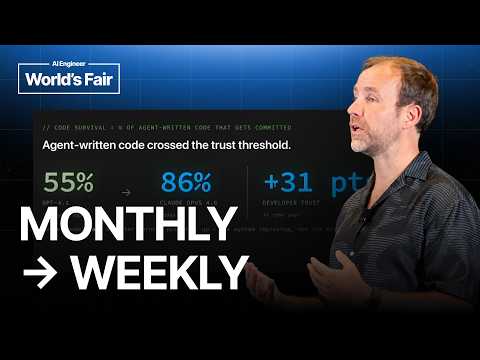
After 10 years of monthly releases, VS Code now ships weekly. It wasn't more AI that made it work. It was rebuilding the whole system around it. Harald Kirschner, principal product manager on VS Code at Microsoft, explains how a small team shipping to more than 50 million users moved from monthly to weekly releases with AI agents, and what broke along the way. He covers three stages: shipping faster (agent-ready codebases, skills, TypeScript Go's 10x faster builds, letting agents drive the app), holding quality (mandatory AI code review, AI issue triage, error stacks that turn into auto-fix P
agent, ai_product, engineering
09
No Mac Mini, no laptop agent. Jeremy Adams runs his personal AI agent on an old Raspberry Pi he wears around his neck. Jeremy Adams, senior developer advocate at Neo4j, assembles a wearable AI agent live on stage: NanoClaw on a Raspberry Pi 4B, messaged over WhatsApp, with Docker-isolated agents and a Neo4j graph database. He shows how he built graph memory using the POLE schema (person, object, location, event) mid-flight, added voice-to-text through a USB mic and a hardware button, ran an offline mode with a local Neo4j, and walked the AI Engineer expo floor turning booth notes into a graph
agent, ai_product, engineering
10
Models became agents, and the APIs didn't keep up. Google DeepMind rebuilt them. Ivan Leo, developer experience engineer at Google DeepMind, introduces the Gemini Interactions API and Managed Agents. He traces how we went from single completions to function calling to agents, then shows server-side state with interaction IDs (no more hand-managing thought signatures), strongly typed multimodal outputs, mixing built-in and custom tools, and the new steps data model. He then demos Managed Agents, which run the Antigravity harness in a persistent remote sandbox with environment IDs, loadable sou
agent, ai_product, engineering
12
Across thousands of GPUs, hardware failures are guaranteed. Fixing them by hand at 3 a.m. doesn't scale. Connor Guerrero, Young Jeong and Nikhil Gupta from Crusoe explain why they built Managed Slurm on top of Kubernetes. Slurm gives researchers gang scheduling, topology awareness and familiar sbatch workflows, but falls short on dynamic resources, node health and observability. Kubernetes fills those gaps without either team changing how it works. They walk through AutoClusters' fully automatic remediation of an XID 79 GPU failure, then demo killing a GPU mid-training and resuming from check
agent, ai_frontier, ai_product, engineering
13
Building AI Agents for Everyone
Gumloop (YC W24) is an AI agent builder used by companies like Shopify, Gusto, and Instacart. It lets employees build and share agents that automate work across their existing tools, while IT controls security, data access, and costs. In this Fireside, co-founders Max Brodeur-Urbas and Rahul Behal talk to Y Combinator General Partner Gustaf Alströmer share how better models transformed their visual workflow builder into an agent platform, what they learned from 1,100 customer calls, and how one power user helped them land Instacart. They also explain why bringing agents into tools like Slack
agent, ai_product, market, product, security, startup
14
Which GPU clouds are worth trusting with your AI workloads? This Lightning podcast episode explores SemiAnalysis’s ClusterMAX 3.0 and the questions that matter when evaluating managed GPU clusters. About the research: ClusterMAX evaluates configuration, workload performance, reliability and response to failures through hands-on testing, documentation review and customer feedback. Explore the research: ClusterMAX 3.0 report: https://newsletter.semianalysis.com/p/clustermax-30-the-industry-standard Rankings: https://www.clustermax.ai/v3 Methodology: https://www.clustermax.ai/overview Evaluati
ai_frontier, engineering, market, startup
08

Papers

01
现有基于评论家梯度的连续控制RL方法依赖不准确的动作导数,导致策略更新不可靠。FERPO 在策略改进目标上加入熵和KL正则,直接从评论家值推导出目标动作分布,然后用自归一化重要性采样最小化前向KL来拟合actor,无需对评论家求导。此前向KL鼓励覆盖多个高价值模式,提升探索且在MuJoCo Playground和ManiSkill实验中表现竞争力、样本效率更高,且actor更新速度比REPPO更快。
02
TACO 通过在每列权重中只保存最大幅度项的符号,实现一阶梯度的近似最速下降,使优化器状态内存从 AdamW8bit 的 27.7 GB 降到 0.16 GB(降低 174 倍),峰值训练显存从 80.6 GB 降到 27.5 GB(降低 2.9 倍),在 OPT‑13B 上精度与运行时间几乎不变,并能在单张 80 GB H100 上完成 30‑32B 参数模型的全参数微调。这意味着在资源受限的环境中,工程师可以直接在消费级显卡上进行大模型的全参数微调,加速产品迭代。
03
VISTA 为多模态模型装上可随时调取的无损视觉记忆,使其能在交互环境中进行长时程视觉推理。在 ARC‑AGI‑3 上把 Claude Opus 5.0 的效率从 40.68 提升到满分 100,且比首次人类玩家少用 57% 的动作。其简洁设计可迁移到其他视觉游戏与谜题,显示为通用视觉手套的潜力。
04
SILSA 解决高分辨率 3D 生成中 voxel 碎片化导致的算力高、拓扑易失问题,采用三轴滑动窗口切片 latent、Slice VAE、共享 Volumetric Anchor Lattice 并用持续图拓扑监督实现单阶段生成。实验表明 token 数比最紧凑基线少 70%,训练显存下降 40.4%,推理时间缩短 58.5%,同时提升 PSNR、覆盖率和 Betti 一致性,能更好保存薄结构与长距离连通性,对需要低延迟、高真 3D 内容的 Agent 产品很有价值。
05
ScholarCatalyst由184位第一作者标注能激发他们研究的过去论文,构建检索基准。实验显示Agent搜索未超越基础嵌入(0.42 vs 0.48 Recall@20),表明模型缺乏专家文献直觉。这提示需要新训练来赋予Agent类似科学家的广泛检索能力,是构建科学Agent的关键参考。
06
在 diffusion transformer 中,条件嵌入只算一次并在所有去噪步重复使用;作者提出 NEPA,用预测的下一个嵌入作为条件,并在每一步重新计算,使条件随噪声状态自适应。实验表明 NEPA-DiT-XL 在 ImageNet 256 上 FID 1.32,仅需约 REPA 三分之一的训练计算。
07
RPG 通过从离线数据中重建操作能力、在仿真中练习并利用执行反馈、特权状态和视频诊断失败,自动生成新符号技能、改进旧技能并更新系统提示;跨任务评估后,冻结的多模态LLM利用得到的技能库和提示在真机上把28.6%的成功率提升到95.0%,在三个任务的30次物理试验中全部成功。
08
KaliBench 提供了 8504 条自然语言到 Kali Linux CLI 指令的细粒度基准,覆盖 1642 工具、23 维能力和 5 个安全阶段,通过确定性规范化、别名感知评估和多阶段验证(LLM 检验、沙盒执行、人工润色)得到可运行时免费的可验证奖励,表明当前开放权重模型在无工具提示的情况下精确命令准确率不超过 42%,而基于其奖励的监督微调和强化学习可显著提升小模型性能,接近巨型 MoE 水平。