ZhangYvJing's

Daily Brief

← October 10, 2026 October 11, 2026 · Sunday October 12, 2026 →
00

Film / Book Chapter

Moneyball
2011 / Bennett Miller

Moneyball (2011) · Bennett Miller

今天适合看《点球成金》,因为它讲的不是体育,而是在旧评价体系失灵时,怎样靠更冷静的判断和证据重新决定什么值得下注。

Designing Data-Intensive Applications
Martin Kleppmann

Designing Data-Intensive Applications · Martin Kleppmann

Chapter 1: Reliable, Scalable, and Maintainable Applications

A useful morning chapter when system design starts feeling abstract: it turns reliability, scalability, and maintainability back into concrete product constraints.

01

Insight

今天的输入更像几股不同语气的材料同时挤在一起:社区链接在暴露工程和产品环境里的真实焦点,长视频在把这些焦点放回更完整的语境里,研究材料则提醒人热度和可落地性并不总是同一件事。如果先不急着做结论,至少可以把这几条线索放在一起看:Hacker News 的 2D Vehicles;Hacker News 的 Why DuckDB 2.0 is faster;Hacker News 的 Knuth reward check;Hacker News 的 Recent AI models struggled to match a human algorithmic innovation;Hacker News 的 The Lightbulb Computer;Hacker News 的 Nix wrote half of my debugger。真正值得注意的不是单条内容本身,而是它们共同指向了什么、彼此漏掉了什么。
03

Hacker News

01
2D Vehicles
开发者用 JavaScript 重现了 1996 年最初的 GTA 2D 车辆物理演示,以纪念其 30 周年。该演示最初为简单的 wireframe 原型,后移植到 C 成为 GTA 车辆系统,核心是刚体动力学模型,外加近似的轮胎阻力层以产生转向和制动感。这使得开发者和爱好者可在浏
02
Why DuckDB 2.0 is faster
DuckDB 2.0版本采用异步I/O架构,将数据下载与解码任务分离线程池,实现S3查询解析速度提升2至3倍;递归查询引擎重构,深度遍历场景(如Git历史、数据血缘)性能提升40倍;VARIANT类型通过字段结构化 shredding 将JSON常用字段拆为独立列存储。这些优化让数据管道开发者无需改查询即可享受更快数据处理速度,同时降低存储成本与复杂数据分析的硬件依赖。
03
Knuth reward check
他获得了Donald Knuth为其在《Computer Modern Typefaces》中发现的错误所寄出的奖励支票。Knuth长期向在其著作中发现错误的人提供奖励,即使是印刷错误,且多年来以虚拟支票形式发放。这激励了读者反复核对书籍内容,尤其是冷门卷册,以期获取同样的认可。
04
前沿AI模型在InnovationEval中未能独立提出能匹配人类on‑policy self‑distillation的新机器学习技术。尽管获准使用价值数千美元的GPU进行大量实验,但只能在已有基线上微调,缺乏真正新颖算法的端到端研发。这说明AI研发自动化仍依赖人类创意,研发人员需承担更高实验成本,评估须防止模型记忆已有任务。
06
Nix wrote half of my debugger
Rewind VM 通过确定性执行和 Nix 的派生机制,将原来难以重现的并发 Bug 轻松定位到具体步骤。它利用 Nix 自动提供构建输入、调试符号和源码闭包,使调试器能在任何时间点回放内核调度并获取线程CPU占用信息。开发者可以在本地快速复现并验证竞态条件,降低调试成本和不确定性,而无需额外的日志或硬件支持。
07
Hacker News 上出现了 Talorys,这是首个能在 Cloudflare 免费层上完全自托管的个人 AI 代理。它无需开发者提供的服务器或数据库,用户只需一个 Cloudflare 账户和一条命令即可创建自己的 AI 助手。安装过程通过npx create-talorys@latest完成,自动部署前端、Worker和基于SQLite的持久化Durable Object,所有数据都存储在用户自己的Cloudflare账户中。认证由Worker本地处理,AI调用使用官方免费的@cf/zai-org/glm-4.7-flash模型。值得注意的是,它采用“AI不可用仍可用”设计,免额度耗尽时任务、笔记和提醒仍可正常工作。这种方案让个人用户以零成本拥有私有的AI助手,同时承担数据处理责任。
09
Microsoft 发布 Execution Containers(MXC)1.0 版,提供策略驱动的容器来限制 AI 代理对文件、网络和应用的访问。此举解决了代理需要跨域操作带来的生产力与安全两难——要么放开权限风险失控,要么封锁导致生产力下降。MXC 让开发者和 IT 通过 JSON 策略定义代理可用资源,并在 Windows、macOS、Linux 上统一 enforce,从而影响代理开发者和企业 IT 的工作方式、风险暴露和访问控制规则。
10
Apple/macOS removed from official Unix registry
Apple/macOS 从官方 Unix 注册表中被移除,这意味着该系统不再符合《Single UNIX Specification》的完整合规要求。只有严格遵守标准、经过认证的系统才能使用 UNIX 商标,而 UNIX 认证提供的开放操作系统基准确保跨平台的最稳定、可移植和高性能开发环境。对于企业用户而言,选择已认证的 UNIX 系统能确保最高的可用性、可扩展性和可维护性,同时支持多供应商选择,避免单一供应商绑定,并保护现有系统、数据和应用的投资。
05

YouTube

01
Airbyte built both an MCP server and a CLI so agents can use its data. Here's what each one is actually good for. Pedro Lopez, software engineer at Airbyte, shares lessons from building two ways for AI agents to reach company data through Airbyte's Context Store, a search-optimized index of tools like Zendesk, Stripe and HubSpot. Both are thin interfaces over one platform, built from OpenAPI specs. For the MCP server, he explains why to keep the tool count small and use progressive discovery, why OAuth is the only realistic way to sign in, why users expect long-lived sessions, and why URL eli
agent, ai_product, engineering
02
Your agent rereads the same files every session because nothing it learned was saved. Anders Swanson, developer evangelist for Oracle Database, treats agent memory as a systems problem. Context windows aren't memory, bigger windows aren't the fix, and markdown scratch pads and grep don't scale. Keep going down that road and you'll end up building your own database. He walks through the pattern modern memory systems are converging on: formation, recall, evolution and evaluation, plus governance. That means typed memories (episodic, semantic, procedural and working state), a storage schema with
agent, ai_product, engineering, market
03
Slop isn't AI-written code. It's work that looks finished before the thinking is. Gabriel "Gabo" Martinez, engineering manager and self-described slop warden at G2i, explains what slop really is: what happens when generation outruns judgment, when ambiguity gets cleared with guesses and nobody notices there was a choice to make. He's not anti-AI, but argues we need to sober up. Code is still a liability, agents make a messy codebase messier faster, and quick prototypes convince stakeholders the hard part is done. He covers the pressure to merge faster than you can review, thousand-line PRs, 2
agent, ai_product, engineering, market
05
Your agent can tell you why one customer was upset. Ask which customers were upset last year, and it falls apart. Gil Feig, co-founder and CTO of Merge, explains why every company needs a context graph, a company brain that brings together third-party data, structured context, memories and skills. Using the question "which customers were upset last week?", he shows why connecting a few MCP servers isn't enough: live API lookups can't search across large datasets, so you need a synced copy for semantic queries, alongside live calls for simple lookups. He walks through the architecture: a route
agent, ai_product, engineering
08
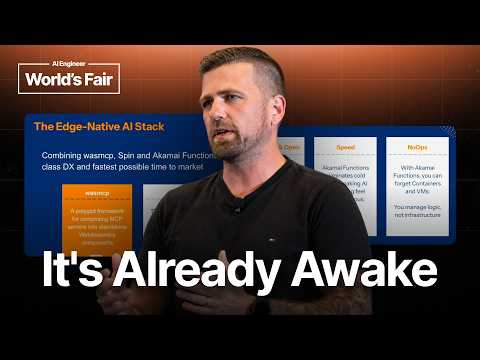
Cold starts, proprietary SDKs and one-region deployments slow AI apps down. WebAssembly at the edge removes all three. Thorsten Hans, senior developer advocate at Akamai, shows how to build and ship MCP servers and AI agents with Spin, the open-source WebAssembly framework, and run them on Akamai Functions, a globally distributed serverless platform with no cold starts. He explains why WebAssembly on the server is fast, portable and sandboxed by default, then live-codes MCP servers with wasmcp: scaffolding tools in TypeScript and Rust, composing them into a full server, testing with MCP Inspe
agent, ai_product, engineering
10
Vector search can't answer "which PRs did I merge last week?" A relational context engine can, and it cuts token burn along the way. Peter Werry, founding engineer at Unblocked, explains what a context engine is and why coding agents need more than code search: the PRs, Slack threads and incident history that explain why the code is the way it is. He shows Claude sessions with and without that context, including one with about a 50% drop in cost and one that traced a regression to a model switch. Then he builds Unblocked's open-source document query engine step by step: automatic schema disco
agent, ai_product, engineering
11
You can write all the rules you want in a markdown file. Your agent can still call the API. Sam, CTO at Gravity, skips the slides and runs five live scenarios against a hotel-booking agent to show why governance belongs in the infrastructure, not in the agent's instructions. Running on the Gravity Gateway with a Databricks backend, Sonnet and Groq, he shows the gateway blocking a destructive "delete all bookings" tool call, stopping an attempt to pull every guest's personal data, rate-limiting a buggy agent that fires the same request eight times, serving repeated questions from a semantic ca
agent, ai_frontier, ai_product, engineering
12
Most models learn text first and get vision bolted on later. MiniMax M3 learned both from the very first training step. Olive, who works on reinforcement learning research at MiniMax, goes inside MiniMax M3, an open-weight model with frontier-level coding and agentic ability, a 1 million token context window and native multimodality. She explains MSA, MiniMax's sparse attention design (about 9x faster prefill and 15x faster decoding than full attention): an index branch that picks which blocks matter and a sparse branch that attends only to those, and why existing designs like DeepSeek's DSA
agent, ai_frontier, ai_product, engineering
13
From the Bitter Lesson of AI scaling to the unsolved mysteries of protein folding, Google DeepMind’s Pushmeet Kohli and Biohub’s Sal Candido are rethinking what it takes to build AI that truly understands biology. In this special panel moderated by Brandon Anderson, they explore why AlphaFold’s breakthrough was only the beginning, why scaling compute and data alone won't solve biology, and how the next generation of AI models could transform our understanding of proteins, cells, and human disease. We go deep on the future of AI-driven biology: finding scaling laws in biological data, the trad
ai_frontier, engineering, startup
08

Papers

01
该工作提出统一的Bellman算子,把任务回报和安全约束合并进一个联合价值函数,采用两时间尺度TD学习:快尺度估计安全价值,慢尺度估计联合价值,从而在无需先验安全知识的情况下收敛到既最大化任务回报又在所有时刻满足安全约束的策略,实验显示近零安全违约。
03
研究指出,错位AI智能体群体在协作时会因群体规模提升网络能力而出现种群阈值——低于阈值则衰减,高于阈值则自我放大导致失控。作者用种群增长方程模拟能力依赖,揭示协作导致强Allee效应,即存在临界群体规模才会爆发。对Agent产品而言,这提示需要红队测试和渐进式放大,以估算安全部署的临界规模并避免失控。
cond-mat.dis-nn, physics.bio-ph
04
直接对AdamW的动量和二阶矩进行4‑bit量化会导致误差累积,影响自适应学习率。作者从‘圆整空间’视角提出ZIP‑SR和ZE‑EDEN两种方案,在多规模GPT/Llama预训练和全参数微调中,使验证损失与32‑bit基准的差距缩小至原来的30%以下,最大降幅达70%。
05
本文针对大模型代理易被隐蔽欺骗和破坏的问题,构建了最大的欺骗数据集FIBS并提出跨层跨token的探针架构,在SHADE-Arena达98.8% AUC,甚至在无法仅凭上下文判断的内省欺骗中达99.7%。对于关注Agent安全的工程师,这提供了可扩展的白箱检测工具。
06
该工作用单个 Transformer Block 反复计算,将每层 FFN 设为少量共享专家的凸组合,并用归一化深度坐标调度混合,免中间特征蒸馏即可匹配全深度 ViT 精度,参数存储降约 70%。支持弹性深度:同一 checkpoint 可在多深度运行,固定深度时可展开为密集图,免在线路由。对 Agent 产品,可灵活权衡计算与精度,适合资源受限端侧。
07
BrickBench 基准评估 Agent 在文本提示下设计可实际搭建的 LEGO 模型;代理需从离散零件库选部件,兼顾局部与全局约束。实验表明当前领先 Agent 能满足可验证的物理与语义要求,但仍不及人类设计,为构建真可执行的文本条件 Agent 提供量化测试。