01
ZhangYvJing's
Daily Brief
00
Film / Book Chapter
Moneyball
Moneyball (2011) · Bennett Miller
今天适合看《点球成金》,因为它讲的不是体育,而是在旧评价体系失灵时,怎样靠更冷静的判断和证据重新决定什么值得下注。
Thinking in Systems
Thinking in Systems · Donella H. Meadows
Chapter 1: The Basics
A clean way to see feedback loops, stocks, flows, and delays before turning every technical or life problem into a single-variable optimization.
01
Insight
今天的输入更像几股不同语气的材料同时挤在一起:社区链接在暴露工程和产品环境里的真实焦点,长视频在把这些焦点放回更完整的语境里,研究材料则提醒人热度和可落地性并不总是同一件事。如果先不急着做结论,至少可以把这几条线索放在一起看:Hacker News 的 No Signs of AI Payoff Outside the Tech Sector;Hacker News 的 The Goose Programming Language;Hacker News 的 Roku developer repositories moved from GitHub to GitLab;Hacker News 的 John Carmack on the Goose Language: multiple data stacks and relative references;Hacker News 的 Listen and read USA nuclear forces Emergency Action Messages, heard on 11175 kHz;Hacker News 的 Dream-1。真正值得注意的不是单条内容本身,而是它们共同指向了什么、彼此漏掉了什么。
03
Hacker News
02
03
Roku将开发者资源库从GitHub迁移到GitLab,这一变更要求用户在浏览器中启用JavaScript才能访问该网站。由于网站依赖JavaScript才能正常工作,开发者在迁移后需确保浏览器设置正确,否则无法查看或访问这些代码仓库。这对依赖Roku平台开发的团队造成简短的访问中断,可能增加额外的配置步骤和潜在的技术问题排查成本。
04
John Carmack 介绍了 Goose 语言,它支持多个数据栈和可调节字段。这让数据处理从“只是可以完成大量工作”提升到“几乎所有工作都可以用这种方式完成”。该语言还内置相对引用和二进制结构校验,使得数据结构可以直接内存映射,网络数据也能立即使用。传统的解析文件和网络数据的方式往往慢百倍,这种新方法大幅降低了这种开销。对于需要高性能数据处理的开发者来说,这意味着可以直接使用网络传输的数据,无需额外的解析步骤,从而减少开发成本和潜在风险。
05
06
07
08
FreeDNS推出免费DNS托管服务,支持动态DNS、静态DNS、子域名和域名管理,会员现已达716万,服务处理每秒2374个DNS查询。平台提供Web跳转、IPv6反向DNS和自动IP更新功能,用户可通过curl命令简单更新域名解析。免费用户可访问232万共享域名注册表,premium方案每月仅需5美元。服务机制通过自动化接口实时同步IP地址,支持v1和v2版本,IPv6更新同理。该服务降低了个人用户和小型组织的域名管理成本,同时通过比特币支付扩展了支付方式。
09
10
04
GitHub Trending
Daily · Top 10
01
02
03
04
Nutlope/hallmark 是一個面向 Claude Code、Cursor、Codex 等 AI 開發工具的設計技能專案,以 CSS 為主要語言,目的是阻止生成的內容看起來像機器人製作。它的核心能力在於擁有四十八個主題模板,從「紙本、排版、顏色、質地」等材料角度驅動設計,並內建「防 AI 跡跑」的檢測機制,如檢查標題上方的眉毛、首字母大寫標籤、每頁結尾的註冊表單等。運行時,它先完成預飛檢查,再以實瀏覽器實驗性檢測畫面,甚至用子代理師從「新鮮」的視角審視結果。適用於 AI 編寫網頁界面的粗糙輸出,幫助開發者產出更貼近人類設計師風格的響應式頁面。
05
06
07
08
09
10
05
YouTube
01

Joseph Kim leads ChatGPT for Financial Services, which launched a month before this talk with design partners Morgan Stanley and Evercore. He demos the product and explains the "capability overhang": the gap between what models can do and the value people actually get from them at work. He covers why the team licensed and indexed financial data themselves instead of relying on existing MCP connectors, and how firm templates, interactive charts and citation viewers were built on the same ChatGPT plugin platform open to developers. He then looks at where models are headed, the point where a task
02

Affaan Mustafa and Alejandro Soumah Fernandez lead compute trading at Jump Trading. They explain why most GPU capacity still trades out of public view: private quotes, bilateral contracts and deals struck over Slack, X and Telegram. They look at why GPU prices have held up even as token prices fell, how chips, power, buildings and capital all feed into the price of a GPU hour, and why mid-size companies get squeezed when a 15 to 25% prepayment on a three-year contract can eat a whole funding round. They also cover brokers, exchanges, futures and flexible contracts, export controls, and why the
03

Andrey Rybka of Bloomberg walks through real security incidents involving AI agents and the controls that would have stopped each one: an agent that escaped its sandbox and took 17,600 actions over four and a half days, a zero-click email injection, instructions hidden in Morse code that drained a wallet, data smuggled out through DNS lookups, a poisoned MCP package, and an agent that dropped a production database after promising not to touch prod. His layered defense: one identity per agent with short-lived scoped credentials, treat all input as hostile, route every tool call through a determ
04

Full episode: https://www.youtube.com/watch?v=frYSOKvNiiE Me on twitter: https://x.com/dwarkesh_sp
05
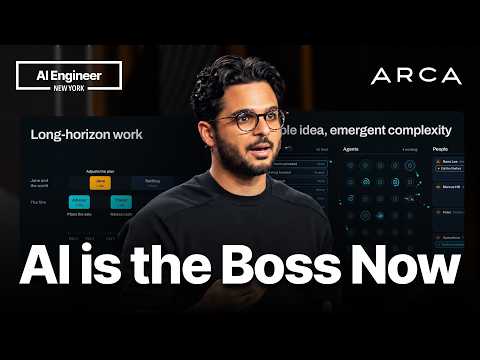
Arca is an AI-native financial services firm where agents don't assist the business, they run it. Aman Singh, who leads AI at Arca, shows how long-horizon agents own a client goal end to end across days of stop-start work: a signal system that keeps agents aware of emails, calls, custodian events and in-app actions; operational context and a harness to do the work; persistent memory; and shared spaces where agents pull in the right person at the right time. The result: agents prompt people more than people prompt agents, and the firm steers the business by steering its agents. Chapters 00:00
06
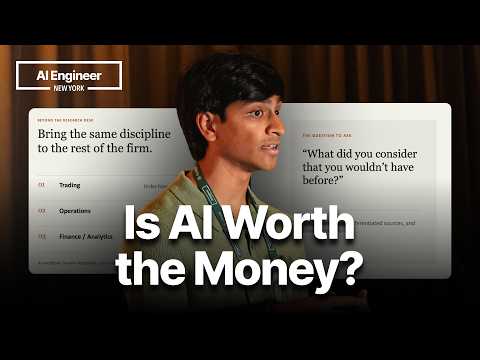
Hari Kumar, head of AI at Contour Asset Management, a $6B fundamental long/short fund focused on tech, media and telecom, tackles the hardest question in AI adoption: what are we actually getting for the spend? He shares how Contour runs live A/B tests of analysts' research with and without AI tools, tracks "cost per useful insight," uses agents to resurface old ideas when the market makes them interesting again, and extends the same thinking to trading, ops and compliance. Chapters 00:00 Intro: AI at a $6B fundamental fund 01:45 Why AI ROI is so hard to capture 02:25 Live A/B tests of resear
07

Harneet Kaur, founder and CEO of Axim Intelligence and a former distressed credit investor, tests whether frontier models can reason about a live distressed situation: iHeartMedia. Given the same context, two top models disagreed sharply on the odds of bankruptcy versus a negotiated restructuring. Breaking the analysis into checked layers (extraction, derivation, judgment, prediction) brought them to the same answer, which raises a new question: is agreement the same as being right? Chapters 00:00 Intro 00:42 What distressed credit actually means 02:34 Why old scoring models fall short 04:30
08

09

Bridgewater Associates built the Vault: more than 100 million documents from 135 external sources plus the firm's own memos and meetings, cleaned, permissioned and tagged to its internal ontology. Sam Green (team lead, Applied AI) and Aaron Linsky (head of product engineering) share three lessons: humans and agents need different things from search, the biggest wins come from one tool that serves both, and the real prize is agents that proactively bring investors what deserves their attention. Includes how a hand-built benchmark took precision at 10 from about 60% to over 90%. Chapters 00:00
10

Full episode: https://www.youtube.com/watch?v=frYSOKvNiiE Me on twitter: https://x.com/dwarkesh_sp
11

A one-line prompt change made a support agent 17 points safer and 17 points worse at finishing tasks. Sofia Jakovcevic, forward deployed engineer at Arize AI, explains why agents fail at runtime rather than in code, and walks through a five-step regression loop built from production traces: curate datasets, score with evaluators, run baseline experiments, compare changes, and gate merges in CI. Then she shows how to close the loop at agent speed, with coding agents that read traces and fix themselves. Chapters 00:00 Intro: observability for agents 01:08 The real problem: fixes that break othe
08
Papers
01
02
03
04
05
06
07
08
09
Issue Monitor
Ready now138Actionable issues
Needs review20Awaiting a fresh check
Data statusFreshUpdated 0.79h ago