01
ZhangYvJing's
Daily Brief
00
Film / Book Chapter
Moneyball
Moneyball (2011) · Bennett Miller
今天适合看《点球成金》,因为它讲的不是体育,而是在旧评价体系失灵时,怎样靠更冷静的判断和证据重新决定什么值得下注。
The Staff Engineer's Path
The Staff Engineer's Path · Tanya Reilly
Chapter 2: Three Maps
Good for calibrating work beyond code: where influence actually travels, which systems matter, and how to avoid mistaking activity for leverage.
01
Insight
今天的输入更像几股不同语气的材料同时挤在一起:社区链接在暴露工程和产品环境里的真实焦点,长视频在把这些焦点放回更完整的语境里,研究材料则提醒人热度和可落地性并不总是同一件事。如果先不急着做结论,至少可以把这几条线索放在一起看:Hacker News 的 HackerTube: YouTube built from videos recommended by HN;Hacker News 的 Show HN: HackerBooks – HackerTube, but for books mentioned on HN;Hacker News 的 Apple captures 50% of consumer revenue of the top half of the S&P 500;Hacker News 的 Nibnib: Image compression with extreme decompression speed;Hacker News 的 Mathematics has changed. Let's act like it;Hacker News 的 Tips for more effective fuzz testing with AFL++。真正值得注意的不是单条内容本身,而是它们共同指向了什么、彼此漏掉了什么。
03
Hacker News
02
03
04
05
06
07
08
09
10
04
GitHub Trending
Daily · Top 10
05
YouTube
01

02

Full episode: https://www.youtube.com/watch?v=f0J_EeW42Lo Me on twitter: https://x.com/dwarkesh_sp
03

Richmond Alake was talking about agent memory before most people had heard of it, and now he argues the next layer after the control plane is an intelligence plane: what an agent knows, what it remembers, what it's allowed to see, and how it gets better. Using the WWII codebreakers who worked out that "AF" meant Midway, he shows why having the same information as everyone else isn't the same as intelligence. He then demos an agent built with an ontology and semantic layer that gets answers right 99% of the time using 32K tokens, versus 200K for a naive agent, and covers Oracle's agent memory p
04
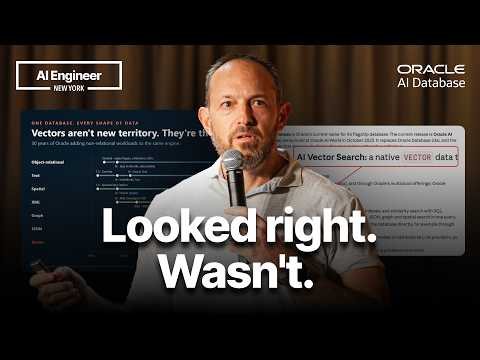
Jeff Smith has built database tools at Oracle for 25 years, and he's here to make agents and databases get along safely. He explains why natural language to SQL is powerful but risky, since queries can run cleanly and still return the wrong data, and how Oracle's MCP server makes it safer: offering your team's vetted reports as tools instead of ad hoc SQL, pointing agents at a read-only standby for performance tuning, annotating schemas so agents stop brute-forcing your data dictionary, and deep data security that strips out rows a user isn't allowed to see before results ever reach the agent.
05

Ramakrishnan Lokanathan, an AI safety researcher and former startup founder, lays out how to build evals for high-stakes AI applications. Define the most ambitious version of success, test every step of the workflow and not just the final answer, combine automated checks with human review and adversarial tests, keep testing what used to work so upgrades don't break it, and turn real user failures into new tests. He also introduces eSlams, an open-source package that has AI models play games like chess, Go and poker against each other as another way to see how they reason. Chapters: 0:00 Intro
06

In this fireside chat, Mintlify co-founder and CTO Hahnbee Lee and Coinbase head of AI product Lincoln Murr discuss what changes when agents, not people, are the main users of your product. Lee shares that agent traffic on Mintlify docs sites grew from about 10% to about 80% this year, why page size and accuracy now matter more than design, and where AI writing fits. Murr explains why Coinbase is making its whole business available through APIs, how the x402 payment standard has seen around 100 million on-chain agent transactions, and why giving agents money makes them more autonomous. Chapte
07

Yijia Liang spent years as a finance analyst living in Excel and PowerPoint before founding Compound to build autonomous AI analysts for institutional investors. Personal agents took off because they run reliably in the background, act on their own and connect to your context, but finance needs more: multiplayer agents with their own inboxes that join deal-team email threads, a headless Office engine rebuilt from scratch with agents (1.5 trillion tokens and over 8 million lines of code) that runs work in parallel and checks its own formatting, and agent swarms that can work through data rooms
08

Full episode: https://www.youtube.com/watch?v=f0J_EeW42Lo Me on twitter: https://x.com/dwarkesh_sp
09
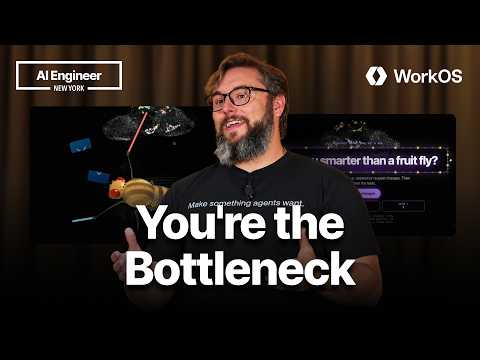
Code is being written faster than ever, and Nick Nisi, who leads developer and agent experience at WorkOS, argues that the human reviewer is now the bottleneck. To make the point, he hooked a simulated fruit fly brain, built from a full scan of its neurons, up to code review: AI turns each change into literal "code smells," sugar and bitter rewards teach the fly what good and bad code taste like, and it was right about 88% of the time in testing. Then he plays a live round against the audience and lays out a practical plan where team review skills, classifiers and automated reviewers only send
10

Arca head of AI Aman Singh joins Latent Space head of editorial Richard MacManus at AI Engineer New York, to discuss how Arca is building an AI-native wealth management firm. Singh explains Arca's architecture, which includes a custom harness and persistent memory. He also digs into how Arca runs agentic workflows that span days, not hours. Arca: https://arcawealth.ai/ AI Engineer: https://ai.engineer/ Latent Space: https://www.latent.space/ Chapters: 00:00 Introducing Arca’s AI-native wealth management firm 01:40 How AI supports human financial advisors 02:40 Choosing models with internal
08
Papers
01
02
03
04
05
06
07
08
09
Issue Monitor
Ready now153Actionable issues
Needs review23Awaiting a fresh check
Data statusFreshUpdated 0.65h ago