01
ZhangYvJing's
Daily Brief
00
Film / Book Chapter
Ikiru
Ikiru (1952) · Akira Kurosawa
在面对代码审查、AI模型裁剪以及永不停歇的项目迭代时,今天的《活着》提醒你:即便只剩下最后一次可落实的功能,仍要把它做得有意义,这种对“剩余时间”与“真实价值”的审视,正好校准了你在繁杂任务中对核心产出和个人使命的判断。
The Pragmatic Programmer
The Pragmatic Programmer · David Thomas / Andrew Hunt
Chapter 1: A Pragmatic Philosophy
A compact reset on ownership, taste, entropy, and being the kind of engineer whose work keeps improving after the first pass.
01
Insight
今天的材料整体指向了“从底层工具向业务化、合规化、可审计化迁移”这一趋势:在技术层面,Mistral、Liquid AI、Cursor 与 LFM2.5 通过小模型本地部署、数据高效排序、用户需求驱动的自上而下训练以及边缘推理,明确把“算力、模型规模不是竞争核心”搬到前台;而在治理层面,加州《保护我们的游戏法案》把数字产品的持续可访问性写进法律,LLMSurgeon 与多模态一致性论文则提供了审计与纠错的工具链,暗示监管对数据来源和模型行为的可追溯要求正在形成。与此同时,YouTube 上的 Neuralink、Jeeves、Neo4j、Braintrust、Reachy Mini 与 Cognition 的背景代理讨论,展示了硬件‑AI 融合、决策可解释图谱以及端到端的金融/机器人业务落地,这些都在用实际场景验证前述工具化的价值。值得注意的是,Hacker News 上的“死经济理论”与“游戏保护法案”形成噪声对比:前者把 AI 内容泛滥视为宏观失业风险,却缺乏可操作的治理路径;后者则在立法层面直接约束商业行为,两者在焦点上出现错位。arXiv 方面,数据组织(STR/SAW)和测试时微调(HullFT)提供了低成本提升训练和推理效率的实用方法,正好呼应了 Mistral 与 Cursor 提出的“先满足用户需求再做模型”。这说明研究热点正从纯粹的模型规模竞争,转向训练数据、推理效率和合规可审计的细节优化。综合来看,今天应把注意力从“更大模型”转向“更安全、更合规、更高效的落地链”,在选型时优先考虑本地部署、可解释决策图和数据溯源工具,毕竟真正的竞争力已经不在云端算力,而在能否在监管框架下快速交付可靠产品;顺带一提,今晚不妨看看《Ikiru》,感受一下在制度与人性之间的细腻平衡。
03
Hacker News
02
加州州议会以43票对16票通过了AB 1921《保护我们的游戏法案》,要求数字游戏在停服后仍须保持可访问。该法案源于玩家对2024年一款赛车游戏关闭服务器后无法游玩的争议,推动“Stop Killing Games”运动呼吁出版商在停服前至少提前60天通知,并提供替代版本或退款,以解决购买权与使用权的矛盾。若法案最终获批,数字游戏发行商将必须调整停服流程、准备补丁或补偿方案,从而增加合规成本并改变现有的服务终止计划。
03
AI生成内容已超过网络一半,机器人主导信息流,人与机器的互动被迫转向机器演出。投资数千亿美元的AI公司以取代全球劳动力为商业模型,推出自设基准显示模型在多职业上胜过人类,形成削减人力成本的正向循环。此类劳动力替代将压低专业岗位成本、加大失业风险,并迫使企业和员工重新面对收入与消费的结构性冲击。
04
随着2024年Summit的召开,Mistral宣布从大模型竞争转向开发小型、快速且可本地部署的AI模型,形成全栈欧洲AI供应链。材料指出,核心机制在于通过开源模型、代理编排和高效推理实现能源与成本优势,同时通过本地化部署满足数据主权和合规需求。此举将直接改变金融、制造和公共部门的AI使用方式,使其在数据安全、运算支出和监管合规方面的风险降低,并重新定义业务流程的技术依赖。
05
Diffs 团队推出了 CodeView——一个以虚拟化为首的完整审阅组件,号称可以几乎即时渲染任意规模的代码差异。该组件通过仅在视口附近渲染内容、把语法高亮移至工作线程以及统一处理渲染、处理和内存三大负载,解决了大文件或多文件 PR 中 DOM 膨胀、计算开销和内存占用导致的卡顿与空白。代码审查平台和使用自动生成代码的团队因此可以在不自行构建复杂差异展示层的前提下,降低前端资源消耗并提升审阅效率。
06
bijou64 通过让首字节兼作数值或长度标签并在后续字节加入固定偏移,实现了每个整数唯一的可变长编码。该机制消除了 LEB128 需要遍历连续位并在解码时额外验证规范形式的过程,从而使编码本身即具备规范性,无需额外的合法性检查。使用 bijou64 的协议实现者因此可以在解码和编码时显著降低时延和实现复杂度,同时降低因多重表示导致的签名或去重错误风险。
07
Framework 12的整体体验被判定为“性价比差”,而同价位的MacBook Neo在性能、效率、噪音、做工和显示质量上均优于前者。导致这种差距的因素包括Framework采用更贵的组件仍为降低成本而牺牲了显示色彩、厚重和散热设计,同时只能提供旧版触控笔和较差的扬声器;相对地,Neo凭借规模优势获得高质量屏幕、无风扇静音以及更低的售价。因为价格差距在20%‑40%之间,学生和预算受限的消费者在选购笔记本时更可能放弃可维修性而倾向于Neo,从而降低购机成本并简化采购决策。
08
LFM2.5-8B-A1B 在原模型基础上将上下文窗口扩至12.8万 token,预训练数据提升至38 T,并将词表扩至12.8万。通过中期训练延长 RoPE、两阶段词表适配及针对循环和幻觉的强化学习,使模型在保持小活跃参数的同时实现推理链式思考并提升质量。该模型可在普通笔记本甚至手机上实时调用工具,降低本地私有助理部署成本,改变开发者对边缘 AI 性能与数据安全的规划。
04
YouTube
01

DJ Seo, co-founder and president of Neuralink, joins Sequoia partner Shaun Maguire at AI Ascent 2026 to talk about what it takes to build the bridge between the human brain and AI. He walks through how Neuralink has gone from one human patient to over twenty, what it has been like to watch quadriplegic patients regain control of computers and robotic limbs through pure thought, and where Blindsight — the company's vision-restoration product — stands today. Also: why DJ believes AI will eventually become an exocortex layered above the human neocortex, why the real ceiling of this technology is
02

Angela Strange speaks with Dileep Thazhmon, founder and CEO of Jeeves, about building a global financial operating system for enterprises across Latin America using stablecoins and AI. The conversation covers the challenges of building localized financial infrastructure across 25 countries, from regulation and payments to underwriting and compliance. They also discuss why stablecoin adoption is accelerating in Latin America, and how AI is helping Jeeves scale billions in payment volume while automating underwriting, customer support, reconciliation, and KYB workflows. Timestamps: 00:00 - Int
03
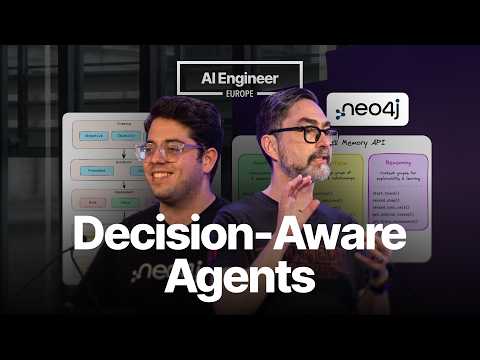
Prescribing drug X is correct 99% of the time for symptom Y. For the 1% where it is fatal, statistical reasoning does not help you. Andreas Kollegger calls this reference class validation: before the agent acts, it has to know which group it is in. Context graphs give agents the why. Not just knowledge and tools but the policies, rules, and prior decisions that explain why a certain action is right in a given context. The decision making framework in this talk has five stages: frame the problem with its causality and environment, pull in global rules and past precedent, run a risk value analy
04

Most labs start from pre-training and scale up. Cursor flipped it. Federico Cassano breaks down the top-down approach: start with what's useful to users, then specialize. The result? A frontier coding model shipped in a fraction of the time. #shorts #Cursor #Composer #AITraining #LLMs
05

Most Enterprise Agentic Projects Are Doomed, Here's Why — Jess Grogan-Avignon & Jack Wang, Accenture
Jess Grogan-Avignon and Jack Wang at Accenture built an agentic application in two weeks. Getting it to production took another 12 months. Not because the code was wrong. Because the infrastructure team, the security team, the AI gateway team, the data governance team, and the application team all had to align before anything could ship. That is not a technology problem, and fixing the code does not fix it. The deeper issue is that GitHub averaged 275 million commits per week in 2025 on track for 14 billion by year end, while the approval infrastructure was never designed for that throughput.
06

Traditional observability answers one question: is the system up? Phil Hetzel from Braintrust argues that question is not the right one for agents. An individual agent trace can exceed a gigabyte. A single span can hit 20 megabytes. The data is semistructured, packed with unstructured text, and still arrives in real time. None of the systems built for uptime monitoring were designed to ingest, index, and actually use that. Braintrust built a custom database from scratch for this problem: a write ahead log for instant visibility, analytical indexes for fast filtering, and a forked version of T
07

A Viking VoIP phone sat in the ElevenLabs San Francisco office for a year. Three senior engineers and ChatGPT could not get it working. Boris from ElevenLabs cracked the undocumented protocol with Claude Code in a couple of days: brute forced all 676 possible two letter command combinations, found 80 valid ones, then set up a TCP proxy between a Windows virtual machine and the phone to intercept and log what the proprietary Windows XP software was actually sending. The last piece was a one byte checksum in the persistence command. Claude reverse engineered the formula by running known input o
08

Frontier labs already train on tons of code, so their models are quietly specialized too. Cursor takes it further — pushing hard on the data dimension and freeing up weights from distractions so Composer can saturate every bit of capacity on software engineering. #Shorts #Cursor #Composer #AIResearch
09

A knowledge base tells a financial analyst agent the risk factors. A context graph tells it whether to reject or accept, because it also carries past decision traces, the reasoning behind them, and how similar cases resolved. Zach from Neo4j walks through how context graphs extend a standard RAG setup with three layers: short term conversation history, long term extracted entities, and reasoning traces that embed into vectors so structurally similar past decisions surface alongside semantically similar ones. The fastest path in is `uvx create-context-graph`, a one-command scaffold that gives
10

Qwen3-TTS shipped at 0.8x real time: one second of audio took 1.2 seconds to generate. Andres Marafioti from Hugging Face spent two weeks fixing it. The culprits were no streaming, 500 autoregressive steps per audio packet with a CPU GPU round trip on each, and a dynamic KV cache that blocked compilation. Static KV cache plus CUDA graph captures brought it to 5.8x real time with time to first audio under 200 milliseconds. The platform is Reachy Mini, a $300 open source robot Hugging Face has shipped to 7,500 people. It arrives unassembled. Talking to it is their most used app by far. The voic
11

From coining “context engineering” to building the infrastructure behind Devin’s 7x PR growth and jump from 16% to 80% of commits across Cognition repos, Walden Yan has had a front-row seat to the background-agent shift. In this episode, Cognition co-founder and CPO Walden Yan joins swyx alongside Cole Murray, creator of OpenInspect, to unpack why everyone is building their own Devin, what changed after the December 2025 model inflection, and why “spec to pull request” is now becoming a real production workflow. We go deep on the architecture of background agents: harness-in-the-box vs out-of
07
Papers
01
这篇论文聚焦 LLM 训练时数据怎么排——传统只讨论挑数据,几乎不管把数据排序成什么样,而实际大模型往往只跑一两遍。作者复用已有的样本得分,几乎不加算力,提炼出四条组织原则(边界锐化、循环调度、课程连贯、局部多样),并据此设计了两套排序算法 STR、SAW。实验表明这些排序能提升预训练和指令微调的收敛稳定性与效果。对做 Agent/AI 产品的工程师来说,直接把这套低成本的 “数据排排坐” 抄进训练管线,可能马上看到模型质量和训练效率的提升。
02
该论文指出,多组件 LLM 代理在各自只看到问题子集时,局部保持概率一致性,却可能在整体上违背基本概率公理,导致组合结果产生显著的概率不一致(用 eps 衡量)。作者提出可在运行时计算 eps 的残差度量,并用层次化的 Boyle‑Dykstra 投影方法强行纠正,使组合始终落在一致多面体上,还提供了实时监控的 e‑process。若你在搭建由多个子模型协同决策的系统,这套工具能直接量化并修复跨模型推理的概率冲突,避免隐形的预测偏差,值得一看。
03
它想解决 Test‑time Finetuning(每次查询都要检索、微调,太慢)这两个瓶颈:检索冗余和微调开销。方法是 HullFT:先用投影无关的 Frank‑Wolfe 把查询向量表示为少量训练序列的稀疏凸组合,得到既相关又多样的 support set;再把分数整数化成重复样本,用 Gradient Reuse 在这些重复样本上复用前向/反向梯度,显著削减微调时间。对追求高效、按需适配的大模型 Agent 产品,这种几乎“即插即用”的几何检索+梯度缓存方案,能在不牺牲效果的前提下把响应时间和算力成本大幅压下来,值得一看。
04
它要解决的大模型推理慢、算力浪费问题:传统让模型逐词生成思考过程会把内部计算和对外输出混在一起。作者提出 Reasoning‑in‑Memory(RiM),用一段固定的特殊 token 作为“工作记忆块”,一次前向传播就把中间思考装进记忆里,再在这块后面直接迭代优化答案,而不再逐步生成思考文本。这样既保持了推理质量,又省去大量自回归生成开销,对想把大模型部署成高效、低延迟 Agent 的工程师非常有吸引力。
05
它解决了把自然语言需求直接变成可编辑 PCB 原理图的难题——传统原理图描述太冗长、工具专属,LLM 很难直接生成。作者先定义了一种语义化的代码表示,用相对位置和引脚名来描述编辑操作,把几何布局转化为语义匹配,随后通过人机协作把开源硬件转换成大规模“指令‑原理图”对齐数据集。凭此,SchGen 能在连线正确率和功能完整性上显著超越通用大模型,展示了只要设计好表示,生成式模型完全可以承担复杂硬件设计任务,值得关注其表示方法和数据构建思路在 AI Agent 产品化中的可迁移性。
06
它要解的核心是:仅凭一个大语言模型的生成文本,逆推出它在预训练时用了哪些领域的数据以及各自占比——也就是“数字DNA”。作者把这个逆向估计定义为 Data Mixture Surgery,提出 LLMSurgeon:先在标签偏移假设下,用软混淆矩阵对分类器输出做校准,再求解约束逆问题,恢复潜在的领域混合比例。通过公开的 LLMScan 基准库验证,方法能高保真地重建数据配比。对做 Agent、模型安全或产品合规的工程师而言,它提供了一种不需要获取原始训练数据就能审计模型来源、排查风险和解释行为的实用工具。
07
它把机器人操作里“看见”和“会动”这两块合并到感知阶段:通过把图像、语言和3D光流三模态构成三元组,用简化的 simplex‑volume + cosine 正则 + 对比损失,让纯图像编码器直接学会动作相关的动态信息。这样得到的视觉骨干在实际抓取、运动策略等下游任务里显著提升鲁棒性,尤其在分布外场景中可提超 20% 的成功率,值得关注因为它把运动理解前置,直接提升 Agent 的通用感知能力。
08
08
Issue Monitor
Ready now—Actionable issues
Needs review—Awaiting a fresh check
Data statusCheck statusLive status unavailable