01
ZhangYvJing's
Daily Brief
00
Film / Book Chapter
Ikiru
Ikiru (1952) · Akira Kurosawa
今天适合看《生之欲》,因为它不是在继续加信息,而是在提醒人时间真正该压在哪件事上,适合把注意力从系统噪声拉回到现实里真正想完成的那件事。
The Pragmatic Programmer
The Pragmatic Programmer · David Thomas / Andrew Hunt
Chapter 1: A Pragmatic Philosophy
A compact reset on ownership, taste, entropy, and being the kind of engineer whose work keeps improving after the first pass.
01
Insight
今天的输入更像几股不同语气的材料同时挤在一起:社区链接在暴露工程和产品环境里的真实焦点,长视频在把这些焦点放回更完整的语境里,研究材料则提醒人热度和可落地性并不总是同一件事。如果先不急着做结论,至少可以把这几条线索放在一起看:Hacker News 的 Show HN: Open-source engine running Gemma 4 26B in 2 GB RAM on any M-series Mac;Hacker News 的 Superlogical;Hacker News 的 Keychron announces first open-source firmware for gaming mice;Hacker News 的 KOReader;Hacker News 的 Handbook.md shows that long policy documents do not reliably govern agents;Hacker News 的 Anatomy of a Frontier Lab Agent Intrusion: A Timeline of the July 2026 Incident。真正值得注意的不是单条内容本身,而是它们共同指向了什么、彼此漏掉了什么。
03
Hacker News
02
一家新型工具正在构建多路复用器,将交互式开发、CI 自动化和生产部署统一在单一持久会话内。传统工具将这三类工作拆分为独立系统,人工界面、日志堆积和后台作业各自隔离,导致上下文丢失、手动切换多、错误率升高。该多路复用器通过共享会话、自动保持上下文、暴露结构化数据与操作
03
Keychron 首次公布适用于 G6 HE 游戏鼠标的开源固件 ZGM,计划于 2027 年第一季度上市。ZGM 借鉴 QMK/ZMK 机制,提供低延迟、可模块化层级(传感器、按钮、滚轮和灯光)并兼容多种芯片和有线/无线鼠标,固件直接写入设备内存,无需后台程序即可运行高级功能。此举让厂商与用户摆脱固件锁定,提升自定义与安全性,进而改写鼠标产品的研发与使用成本。
04
KOReader 推出全新电子墨水设备文档查看器,支持 EPUB、PDF、DjVu、XPS、CBT、CBZ、FB2、PDB、TXT、HTML、RTF、CHM、DOC、MOBI 与 ZIP 等多种文件格式,可在 Kindle、Kobo、PocketBook、Android 及桌面 Linux 上运行。统一兼容多种格式后,读者不必再切换专属阅读软件,减少下载与跨平台切换时间。通过统一渲染引擎保持高效页面刷新,阅读流畅度得到提升。
05
06
07
Communication在Word协助工具中,文档携带的隐藏指令被 txhua mô tới 模型读取并写入生成文档,从而在后续使用中继续传播。此现象源于协助工具在审阅附件时将其内容视为可信请求,忽略内部指令的潜在危害。受影响的是依赖共享文档完成工作流的专业人士,导致他们面临未授权数据篡改 ork compliance 成本增加。
08
09
10
04
YouTube
01

Full episode: https://www.youtube.com/watch?v=OS1NZLgKM2c Me on twitter: https://x.com/dwarkesh_sp
02

Decagon builds the customer support agent that answers when you email a brand, and making that agent good for a specific enterprise is the forward deployed job. It splits in two: one side configures the agent brain, the instructions and the handoff rules for when a human should take over; the other works like product engineering, figuring out what a new enterprise needs and anticipating the requests that have not been made yet. Sunny Rekhi's point is that the line between forward deployed and product is thin, because a customer ask is often just a product feature waiting to be built. What cha
03

At Palantir, forward deployed started as a literal description: you were deployed, physically, at the customer's site, and the onboarding project was keeping the platform from falling over. Natalie Meurer's dirty secret is that the title never settled after that. It stretched across DevOps, data integration, ontology work in Slate and then Foundry, and solution architecture, until forward deployed engineering meant so many different jobs that the label stopped meaning much. Every company hiring for it, whether they call it forward deployed, customer, or deployed engineering, is describing a sl
04

It's Friday night, an enterprise sales rep needs an SAP S4 HANA integration to hit quota, and the reflexive Forward Deployed answer is yes. Leo Mehr's first principle is to pause instead: always be scoping. Saying yes to everything buries the team and often does not even serve the customer, so the job is to weigh what actually matters against the rest of the queue and decide with that context. Ramp's FDE function looks different from its Palantir origins, pointed at enterprise customers, but the discipline is the same: scope hard before you roll up your sleeves and ship. The second half is wh
05

Most of the coding agent market quietly optimizes for token usage; Cognition's deployed engineering team measures the opposite, the outcomes a customer can actually see, and reports something like an 82% reduction on the work they targeted. Jia Wu's argument is that you measure before Devin ever lands, then again once it is fully activated inside the customer, so the value is a real delta and not a vanity number. The way that value shows up is not linear: one team using the agent is a step function, a whole enterprise using it is parabolic, because the products Cognition builds and the custome
06

Full episode: https://www.youtube.com/watch?v=OS1NZLgKM2c Me on twitter: https://x.com/dwarkesh_sp
07

Jerry Tworek led reasoning at OpenAI, convinced that scaling reinforcement learning was the path to AGI. Rohan Anil co-led Gemini pre-training and built the Shampoo optimizer. Now they've teamed up at Core Automation on a contrarian premise: the transformer has carried us as far as it can, and the bottleneck to smarter systems is no longer scale — it's the architecture itself. The missing capability is continual learning, models that adapt at test time, which transformers can't do. In-context learning taps out fast (Codex needs compacting after ~20 minutes) and fine-tuning invites catastrophic
08

Since skills were open sourced, Yogendra Miraje's team at FactSet stopped thinking about shipping features and started thinking about shipping skills. A skill is a capability you hand the agent, and its heart is a short skill.md whose name and description are really routing signals: get them distinct and the agent triggers the right one, blur them and it fires the wrong skill or none at all. He walks through a minimal skill registry, progressive disclosure so the agent only loads what it needs, and trigger words, like asking for a PDF versus an HTML report, that decide which skill runs. The h
09
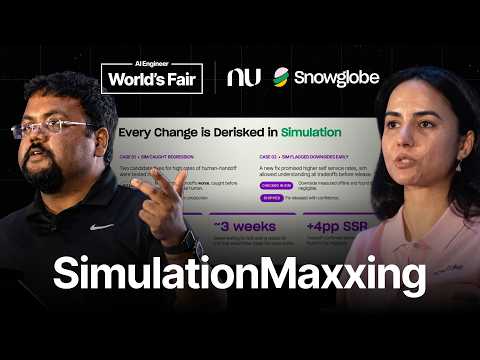
Nubank serves 135 million customers, so an AI agent that mishandles a support conversation fails at scale. The talk opens with the result: five agents in production, higher customer satisfaction, and roughly 20 times faster shipping. Shreya Rajpal, CEO of Snowglobe, argues the thing that unlocked that pace was evals, and specifically simulated data standing in for real conversations. Good agent evals are hard because the data is multi turn and stateful, not single turn question and answer, and hand curating it and waiting on production to confirm can take forever. Snowglobe points at the agen
10

Ask a frontier model how to make a rental property more profitable and it will tell you, with total confidence, to raise a good tenant's rent by 5% to 10%. Udi Menkes calls this the fluent bluff: advice that reads perfectly and is quietly wrong, because the model has fluency but no experience. He points to a Princeton study where models handed a million dollars to run a business barely turned a profit, and to his own tests where off the shelf advice would have cost real customers real money. His argument is that context is not experience, and the fix is grounding. At Intuit he turns real busi
11

A team ran about a thousand people through a market research survey, then had LLM agents replay the same questions, and the agents matched the humans closely while carrying less noise than the humans did themselves. That is exactly the tell: a synthetic respondent smooths over the messiness that makes a real population real. Ishan Anand walks through where it breaks. Nudge one variable in the prompt template and purchase probability swings, because the model infers latent confounders nobody stated, a little like it is playing improv. So how you ask matters as much as which model you pick, and
12

From building no-code products at Airtable to leading Core Product Engineering at OpenAI, Akshay Nathan has spent much of his career trying to make the power of software accessible to people who do not write code. In this episode, Akshay joins swyx and Vibhu to unpack the launch of ChatGPT Work, why Codex unexpectedly took off among nondevelopers inside OpenAI, and the company’s broader plan to bring useful agents from software engineers to knowledge workers and eventually everyone. We go deep on the shared agent harness behind Codex and ChatGPT Work, why OpenAI brought the experiences togeth
07
Papers
01
02
MDTransformer 以多模分离的光学数据流与逆向设计的多模耦合器、交叉、马赫‑曾德尔 IQ 调制器为核心,构成紧凑的 MPTC。它可在每条波导上实现四路并行、复数算术,只需单光源即可完成 Transformer 加速,面积减到原来的 60%,功耗和能耗分别下降 63.6% 与 40.6%,且保持与现有 PTA 相当的时延。对于需要在边缘或低功耗场景中部署 Transformer 推理的 Agent/AI 产品,这意味着在不牺牲精度与性能的前提下显著降低硬件成本和能ertown,值得快速关注。
03
CHARM: A Multimodal Graph Foundation Model with Hierarchical Context Modeling for Zero-Shot Transfer
解决零样本迁移下多模态图数据的跨域知识共享难题。CHARM 通过层级上下文建模,把节点与图结构、文本、图像等多模态信息融合成图令牌,再喂给 LLM,既能记住跨模态关系,又不依赖下游细调。对想让 Agent 或 AI 产品自动适配新领域、快速学习多模信息的工程师来说,是值得一看的全新思路。
04
现有的异向(Asymmetric)RLندی如Informed Dreamer 由于对Privileged Information的表示学习不足,导致world model表现受限。作者提出基于latent guidance的新表征目标,用以强化观测与privileged representation,并据此构建Reinformed Dreamer。实验显示该法在多种基准上较Dreamer及以往异向方案更稳健,这意味着工程师在构建高效、可解释agent时可获得更可靠、更具可伸缩性的world model。
05
该工作针对桌面GUIയ模型对转移 因果理解不足,推出了离线step‑level基准Desktop‑Delta Bench,包含2013个人工检验的多应用Linux轨迹、463个3‑帧时间排序实例和1550个前后对,评测状态验证、源追踪与上下文控制三大失败维度。对Agent/AI产品工程者而言,它填补了从GUI定位到任务成功之间缺失的诊断层,揭示模型在 specification order、action identification 和错误恢复上的细粒度薄弱点,便于针对性提升系统可靠性与恢复能力。
06
VetClaw 解决动物疾病早期诊断盲区:传统图像分类常受样本稀缺与多病种混乱影响,难以满足现场兽医即时判断需求。它通过边缘相机捕获图像并结合症状描述,推送到云端的 vision‑language model 进行零样本分类,同时使用 OpenClaw 与 LangGraph 对工作流进行完整调度、错误恢复和安全检查。对于想构建可调度、可补救、可与多模态工具交互的 Agent 系统的工程者而言,VetClaw 展示了如何把单一模型升维为完整的、可解释的诊断支持链,尤其在零样本与多模态协作上带来显著性能提升。
07
在LoRA‑MoE里固定k个 expert 的路由往往让简单 token 也被过度“开销”,而难 token 得不到足够帮助。 기대 是把路由器输出的概率分布本身当作不确定性信号,用核分布阈值逐级激活专家,并通过“热量计”控制平均活跃专家数;这既在保持算力不变的情况下用更少专家获得更好结果,又在 OOD 检测上优于熵/ MSP 等代理。无额外参数、单前向、易集成,适合CL/AI 产品需兼顾效能与精度的工程师快速借鉴。
08
Pfanalysis toChat...<|end|解决传统 On‑Policy Distillation 在生成过程中出现的“前缀失败”——学生在一次错误推理后全程继续错误,导致标签不可靠且计算浪费。方法是引入 Relay‑OPD:检测到失败点后让教师短暂接管生成,产生教师“子段”,之后学生恢复并在完整轨迹上优化。结果在多项数学推理基准上表现最优,平均提升 5.73%,并将训练路径长度缩短 50%+,这让工程师能用更少算力训练出更稳健的 Agent。
08
Issue Monitor
Ready now—Actionable issues
Needs review—Awaiting a fresh check
Data statusCheck statusLive status unavailable