01
ZhangYvJing's
Daily Brief
00
Film / Book Chapter
Moneyball
Moneyball (2011) · Bennett Miller
今天适合看《点球成金》,因为它讲的不是体育,而是在旧评价体系失灵时,怎样靠更冷静的判断和证据重新决定什么值得下注。
Designing Data-Intensive Applications
Designing Data-Intensive Applications · Martin Kleppmann
Chapter 1: Reliable, Scalable, and Maintainable Applications
A useful morning chapter when system design starts feeling abstract: it turns reliability, scalability, and maintainability back into concrete product constraints.
01
Insight
今天的输入更像几股不同语气的材料同时挤在一起:社区链接在暴露工程和产品环境里的真实焦点,长视频在把这些焦点放回更完整的语境里,研究材料则提醒人热度和可落地性并不总是同一件事。如果先不急着做结论,至少可以把这几条线索放在一起看:Hacker News 的 Read this before you buy that TV streaming stick;Hacker News 的 Advancing the price-performance frontier with GPT‑5.6;Hacker News 的 Gemini Robotics 2 brings whole body intelligence to robots;Hacker News 的 Making Postgres queues scale;Hacker News 的 Stacked PRs are now live on GitHub;Hacker News 的 2x, not 10x: coding with LLMs in 2026。真正值得注意的不是单条内容本身,而是它们共同指向了什么、彼此漏掉了什么。
03
Hacker News
02
03
04
PostgreSQL 已能支持多千工作器并发处理,吞吐量提升至每秒 30,000 条工作流。这一改进基于 FOR UPDATE SKIP LOCKED 避免工作器抢占同一任务,减少锁竞争;同时将事务隔离切换到 READ COMMITTED,消除序列化失败;并将键值索引改为按队列名、优先级、时间戳 atunci的有序部分索 כפי,减轻排序与自动回收开销。结果,依赖 PostgreSQL 进行任务排队的系统可获得更低延迟和更高吞吐,降低对外部队列服务的成本与风险。
05
06
07
08
09
10
CodePen 2.0 正式上线,开发者可在同一编辑界面导入多份 JavaScript 并 npm 包并同步协作。项目从传统单 Pen 迁移为可引用多Role、多文件,统一 npm package.json,降低代码重复且便于 titled 版本管控。通过邀请协同功能,团队能够同时编辑并实时观测演示,直播时即使出现轻微错误也可快速调整。增加 MJML 块后,邮件模板在编辑器内即可完成,无需外部渲染工具,提升工作流程效率。该版本使前端工程师在构建小型网站或教学示例时能直接部署,缩短迭代周期并减少外部依赖风险。
04
YouTube
01

Full episode: https://www.youtube.com/watch?v=OS1NZLgKM2c Me on twitter: https://x.com/dwarkesh_sp
02

Jerry Tworek led reasoning at OpenAI, convinced that scaling reinforcement learning was the path to AGI. Rohan Anil co-led Gemini pre-training and built the Shampoo optimizer. Now they've teamed up at Core Automation on a contrarian premise: the transformer has carried us as far as it can, and the bottleneck to smarter systems is no longer scale — it's the architecture itself. The missing capability is continual learning, models that adapt at test time, which transformers can't do. In-context learning taps out fast (Codex needs compacting after ~20 minutes) and fine-tuning invites catastrophic
03

Since skills were open sourced, Yogendra Miraje's team at FactSet stopped thinking about shipping features and started thinking about shipping skills. A skill is a capability you hand the agent, and its heart is a short skill.md whose name and description are really routing signals: get them distinct and the agent triggers the right one, blur them and it fires the wrong skill or none at all. He walks through a minimal skill registry, progressive disclosure so the agent only loads what it needs, and trigger words, like asking for a PDF versus an HTML report, that decide which skill runs. The h
04
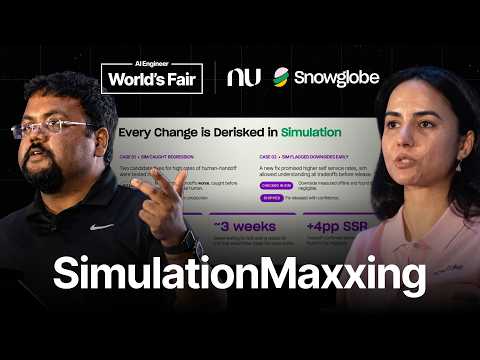
Nubank serves 135 million customers, so an AI agent that mishandles a support conversation fails at scale. The talk opens with the result: five agents in production, higher customer satisfaction, and roughly 20 times faster shipping. Shreya Rajpal, CEO of Snowglobe, argues the thing that unlocked that pace was evals, and specifically simulated data standing in for real conversations. Good agent evals are hard because the data is multi turn and stateful, not single turn question and answer, and hand curating it and waiting on production to confirm can take forever. Snowglobe points at the agen
05

Ask a frontier model how to make a rental property more profitable and it will tell you, with total confidence, to raise a good tenant's rent by 5% to 10%. Udi Menkes calls this the fluent bluff: advice that reads perfectly and is quietly wrong, because the model has fluency but no experience. He points to a Princeton study where models handed a million dollars to run a business barely turned a profit, and to his own tests where off the shelf advice would have cost real customers real money. His argument is that context is not experience, and the fix is grounding. At Intuit he turns real busi
06

A team ran about a thousand people through a market research survey, then had LLM agents replay the same questions, and the agents matched the humans closely while carrying less noise than the humans did themselves. That is exactly the tell: a synthetic respondent smooths over the messiness that makes a real population real. Ishan Anand walks through where it breaks. Nudge one variable in the prompt template and purchase probability swings, because the model infers latent confounders nobody stated, a little like it is playing improv. So how you ask matters as much as which model you pick, and
07

A card gets declined and no one, including the customer, can say exactly why. That gray zone is where Divakar Kumar points his agents. In a payments and fraud system, a rule based engine and an ML model already score most transactions cleanly; the hard cases are the ambiguous ones that neither can resolve. His approach adds an agentic layer on top of an existing event sourced architecture rather than replacing it, so the bounded contexts already in the system, transaction, device, and account, become the context the agents reason over. Events flow through change feeds into projections and a s
08

When a company is about to spend $100 million, Shawn Chan is the person in the room deciding whether it happens, and after fifteen years and roughly 200 investment committees he can spot the flaw fast. Now some of the decks in front of him are AI generated: cleaner formatting, never defensive, and confidently wrong. His frame is the difference between a demo and a memo. A demo is a beautiful confident slice built to impress; a memo is what survives a room whose entire job is to find what breaks. One marketing demo with a single wrong sentence, he reminds you, once erased enormous value the mom
09

The slowest part of shipping a production finance agent is not the model or the GPUs, it is you, the developer in the loop. Ramana Siddanth Emani's point is that the same agent harnesses you use to build products can automate your own developer loop. Coding agents can multiply how much you ship; run an army of them across separate git worktrees and they clear tasks in parallel, with skills making sure each one uses the right patterns. The tasks come from where they already live, QA reports, Jira tickets, GitHub pull requests, and a sub agent pulls the traces and logs, writes and runs end to e
10
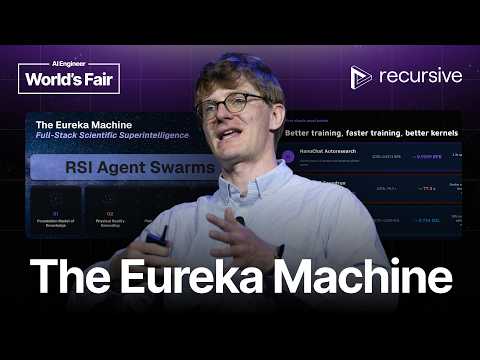
Humanity compressed the road from the enlightenment to the moon landing into a few hundred years, and Richard Socher's wager is that automating research compresses it again. He frames it through open ended evolution and Popper: science advances by trying things, finding the shortcomings, and fixing them, and an agent swarm can run that loop across medicine, economics, astrophysics, and more without any single person bottlenecking a field. He calls the goal a Eureka machine, and argues that rethinking the tools around it, web search that returns usable context instead of ten blue links, browser
07
Papers
01
CT基准模型用整片体积输入,导致细微解剖特征被稀释;细粒度预训练则丢失全局语义并耗费算力。作者提出Anatomy Contextualized Adaptation (ACA),利用TotalSegmentator把CT切成解剖层级嵌入,然后用跨解剖Transformer同时匹配解剖级和扫描级的文本,保留全局上下文且仅需<1小时训练。对Merlin和CT‑RATE的零样本查找分类均优于基线和粗细化方法,且训练轻量、可解释,符合Agent/AI 工程优化和快速部署的需求。
02
研究聚焦如何衡量 LLM 代理在真实办公场景中的“性价比”——把“完成一个文档、报表或邮件链”拆成 100 宏观任务,并给每个任务贴上“人力时长”和“任务价格”两条经济标签。借助代码化评估准则,作者构造了 OmegaUse-OfficeVal 这一长时序且可成本对齐的基准;在对比人类与多款顶尖 LLM 后发现,机器虽快且便宜 gor 仍未逼近人类质量。对想要把人工成本压到位、快速验证模型实际商业价值的 Agent/AI 工程师来说,这套“任务‑成本‑质量”三位一体的评测框架值得快闪检阅。
03
解决电商搜索仅优先精准匹配、忽视替代/互补商品的可发现性难题。作者提出两阶段混合架构:先用大语言模型(LLM)生成意图增强召 اسک,随后用 LoRA·教师‑学生蒸馏微调小模型在低成本下保持召回。采用 LLM‑as‑a‑judge 与真实购买会话评估,系统将查询覆盖率从 60% 提升至 80%,且成本仅为教师模型的 30%,既显著提升用户体验,又为长尾供应商提供曝光,为 Agent/AI 产品工程师提供可落地、成本友好的搜索优化思路。
04
解决在多任务对齐中,快速推断并适应隐藏的伙伴能力,克服传统齐队模型只处理单一任务且假设已知能力的局限。作者提出ైదరాబాద్ CE‑CM,利用上下文模型做近似贝叶斯推断,并在多代理马尔科夫决策过程中在线更新能力向量;随后扩展为 CE‑CM‑Div,通过多样化计划轨迹考量人类行为多样性,显著提升能力估计精度。该方法不依赖预训练、可即时在线精炼,且提供可解释的能力表示,对需要灵活、跨任务协同的 Agent/AI 产品工程师尤为有价值。
05
此论文解决了ovie 从不规则期权报价逆向推断资产的风险中性密度的问题——既要定价精准,也要重获底层分布。作者采用合成受控基准和NIFTY历史报价基准,比较了两元正态混合、DeepONet及Transformer模型。实验表明,深度算子在极值和方差误差上优于混合,但在实盘中需加上先验约束与后验自适应才能真正压制误差。对构造决策或场景仿真的 Agent/AI 工程师 Responsibilities 来说,这表明“万能”模型并不存在,强调前向约束与针对性 inductive bias 的重要性,值得一读。
06
论文质疑 AI 代理是否能真正开展开放式 AI 研究。采用“影子评估”,让代理用千美元算力,独立完成未发表 NeurIPS 论文的核心问题,随后由原作者评分。结果显示,尽管代理能完成工程任务,却在判断可发表标准、创意应对、回溯决策、资源Tcp意识和指令漂移等关键环节屡屡失误,导致两稿直接被拒。对从事 Agent/AI 产品研发的张玉璟而言,这揭示了代理在创新与决策层面的瓶颈,提示需更紧密地结合人类评估链。
07
这篇论文把回归问题转化为分类,借鉴果蝇感知环境的机制,用有限的局部特征库来近似复杂函数。离线阶段从数据或方程抽取特征,在线阶段仅通过相似度计算和加权求
08
这篇研究问:给一个已预训练的策略,Q‑函数还需要预训练吗?实验表明,单纯预训练的Q‑函数对在线微调几乎无益,原因在于预训练的Q与最终收敛的Q存在根本差距。作者提出通过“Initialization via Policy Ensemble”(IPE)——先训练多样化策略,把它们的轨迹池化来启蒙Q‑函数学习,结果在连续控制基准上平均提升1.26×。这打破传统观念,为需要快速上线、调优高效智能体的工程团队提供了一条实用路径。
08
Issue Monitor
Ready now—Actionable issues
Needs review—Awaiting a fresh check
Data statusCheck statusLive status unavailable